

Ask why American healthcare costs so much and someone will hand you a villain. Insurers are the popular pick, but blame in healthcare rides a seesaw, and lately it has tipped toward the hospitals - the systems that bought their neighbors, then their neighbors’ neighbors, until nine in ten hospital markets were highly concentrated. When hospitals merge, prices go up, patients do not get measurably better, and Congress asks the CEOs about it. Yet, the odd thing is how hard these mergers are to see. When two airlines merge, you know within a couple of years (one logo on the tails, one app, one frequent-flyer program). When two hospitals merge, the old names can stay over the doors for decades, and the first place a patient may notice anything is the bill. So here’s the question underneath the fight over hospital prices - what does a hospital merger actually merge?
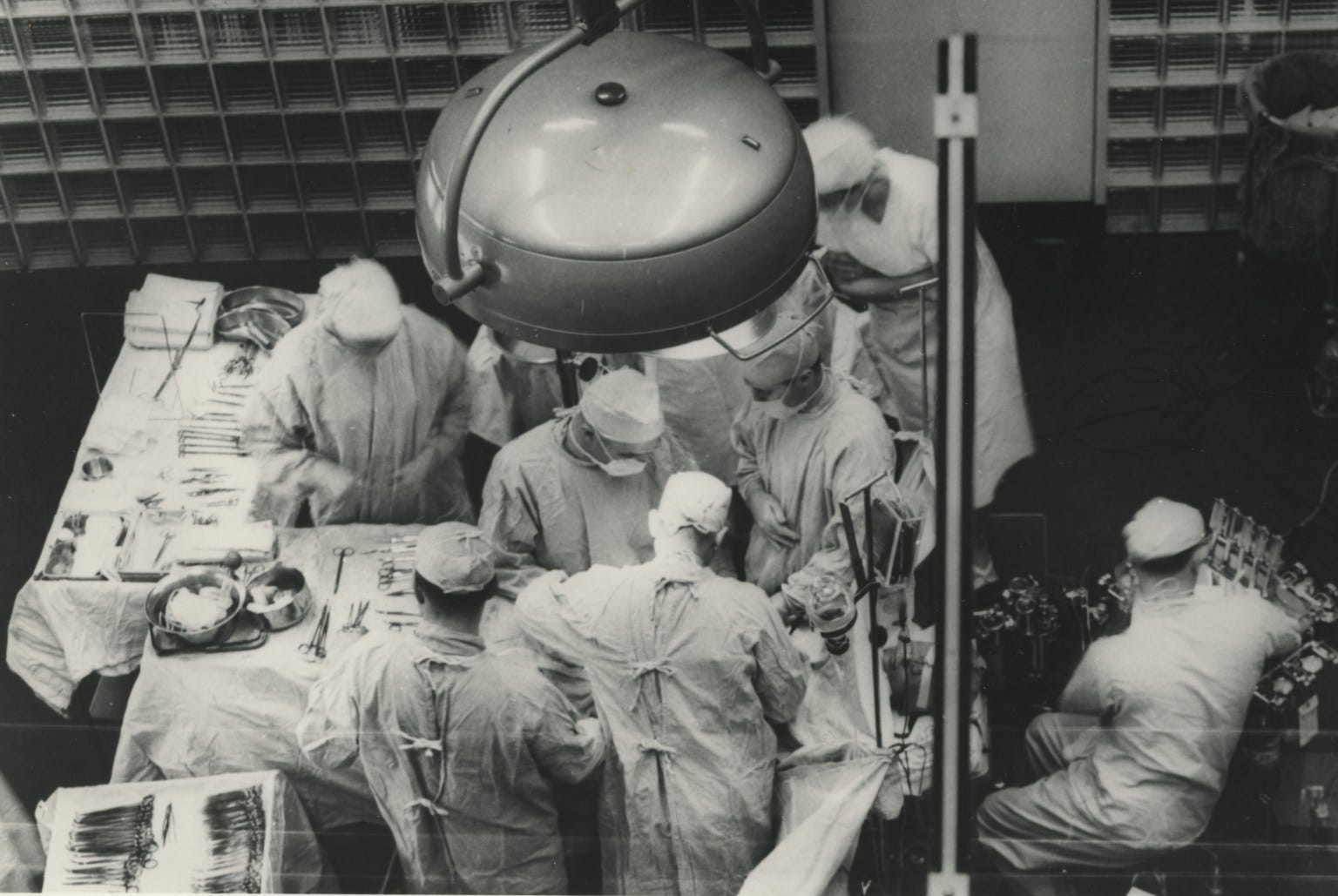
I live outside Boston, I’ve written about the gravity of its healthcare before, and until I got older, I had never paid much attention to Mass General Brigham. I’m not sure how I managed that. Massachusetts General Hospital (MGH) gave the first public demonstration of surgical anesthesia in 1846, in an operating amphitheater that still stands on its campus. Brigham and Women’s (then the Peter Bent Brigham) performed the first successful organ transplant in 1954. Both are Harvard teaching hospitals, which in American medicine is about as prestigious as it gets. Since they .joined forces in 1994, they have won three Nobel prizes and drawn the most NIH research funding of any hospital system in the country, and generations of doctors have trained on their wards. For most of a century they were rivals, three miles apart. With that much money, talent, and patience, if any hospital merger should have delivered everything it promised, it was this one.
Mass General Brigham (MGB) is also, among the people who have to do business with it, something close to hated. Patients tend to love MGH and the Brigham. Insurers, rival hospitals, and state regulators resent the system that owns them, and have spent thirty years trying to rein it in. Rivals called it the “800-pound gorilla,” and the Boston Globe’s Spotlight team spent 2008 digging into its prices. The state even put MGB on its first-ever performance improvement plan, or PIP, to bring its spending down (more on that later). If you live here, the fights over it are part of the local weather.
We’ve looked inside this massive health system before, but this time the question is how it was put together, and the name is the first clue. For twenty-five years the system was called Partners, which may be the only one-word oxymoron. It dropped the name in 2019, the same year it began seriously trying to combine the medicine inside it. For a quarter century, the name described a partnership that had not yet reached the doctors. We’ll look at that distance, between what a merger announces and what it actually joins. This story starts with five hospitals and Harvard.


It comes in three acts, each answering one question:
Act I: Safety in Numbers - Why do hospitals merge?
Act II: Some Assembly Required - How does a hospital actually merge?
Act III: Who Picks Up the Tab - What does it all mean for the rest of us?
Act I: Safety in Numbers
Five Hospitals Walk into a Bar
Daniel Tosteson ran Harvard Med School as dean for twenty years, from 1977 to 1997 - long enough that one of its big buildings carries his name. He often ate breakfast with the hospital CEOs at the Harvard Club. By 1992 he could see them getting more anxious every month as their occupancy fell and their revenue went with it - he was anxious too. Harvard’s med students trained on those wards and its faculty ran those labs, so whatever squeezed the hospitals would squeeze the med school’s mission - creating generations of Harvard-trained doctors.

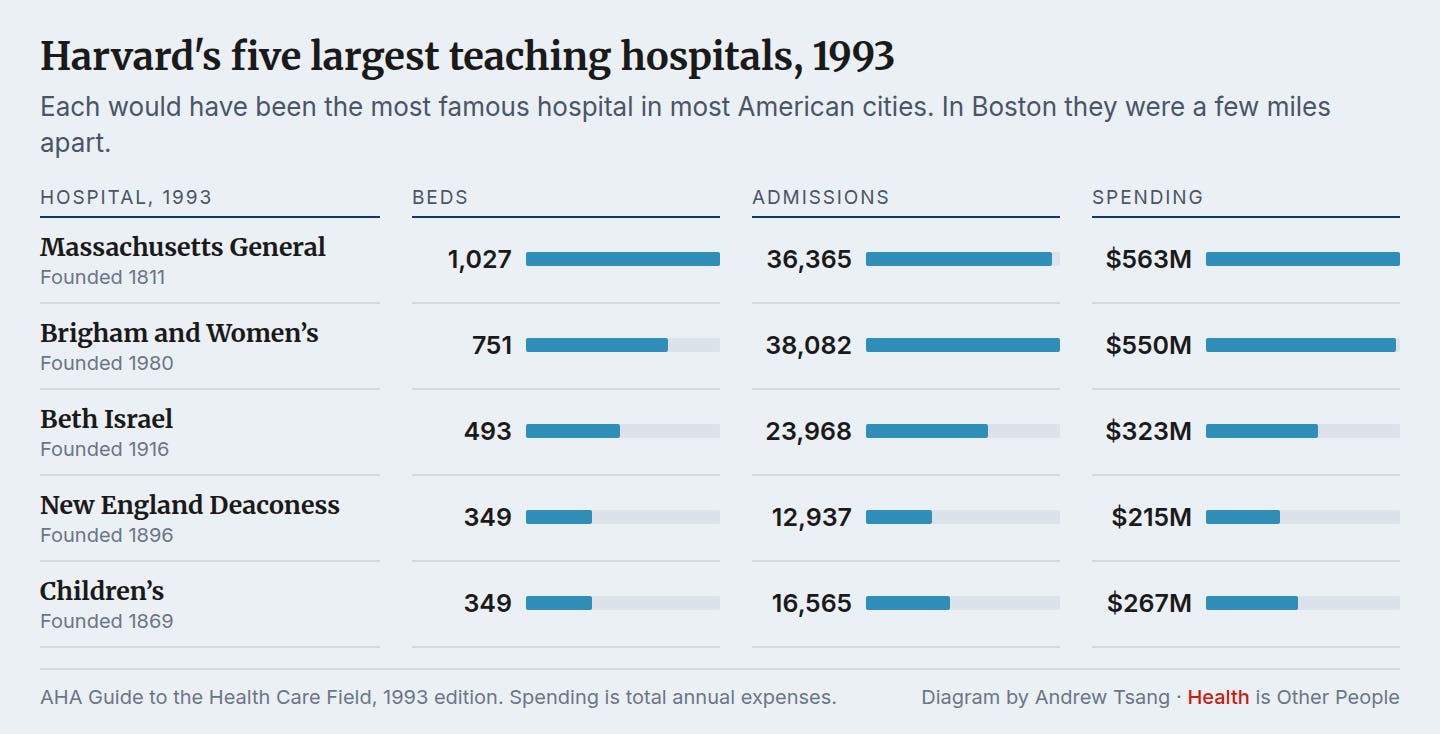
On Tuesday, January 5, 1993, he called the five largest Harvard hospitals into one room. I like to imagine a big boardroom, a long mahogany table, and walls lined with bookcases, portraits of old doctors, and a bust of Hippocrates looking down on the men about to reorganize his profession. Beth Israel, Children’s, the New England Deaconess, Brigham and Women’s, and Massachusetts General - each would have been the most famous hospital in most American cities - and here were all five within a few miles of each other. MGH was, in the Crimson’s phrase, “the Big-foot of this bunch,” and the Brigham, three miles away in Longwood, had spent most of a century trying to outdo it. For one morning, the five families set aside their rivalries to determine the fate of Boston medicine.
What brought them together was the threat of “managed care”. A health maintenance organization, or HMO, enrolls patients, sends them to a network of doctors and hospitals it has picked, and bargains down those hospitals’ prices in exchange for the patients. It shops for hospitals the way a travel site shops for hotels, booking the cheap one for an ordinary stay and the grand one only when nothing else will do. The group had hired highly paid Bain consultants to tell them about the problem they already knew. In a printed slide deck (it was 1993), they read that Harvard hospitals cost about 65 percent more than the cheapest community hospital. An HMO would still send its members to MGH for the rare, terrible case, and send the gallbladders and normal deliveries to the cheaper hospital down the road.
It would be sensible shopping - except the routine admissions paid for everything else. An academic hospital trains the next generation of doctors (in this case, Harvard’s), runs the research that ends up in textbooks, and keeps specialists and operating rooms ready for the complex cases no one else can take. Very little of that pays its own way (standby capacity costs money precisely because no one knows when it will be needed). This is how America pays for academic medicine - the price of ordinary care carries the extraordinary work, and the best prices for ordinary care came from commercial insurers, the same insurers now turning into HMOs. Managed care threatened to cut off the money behind the hospitals’ most sacred work, the teaching and the research.
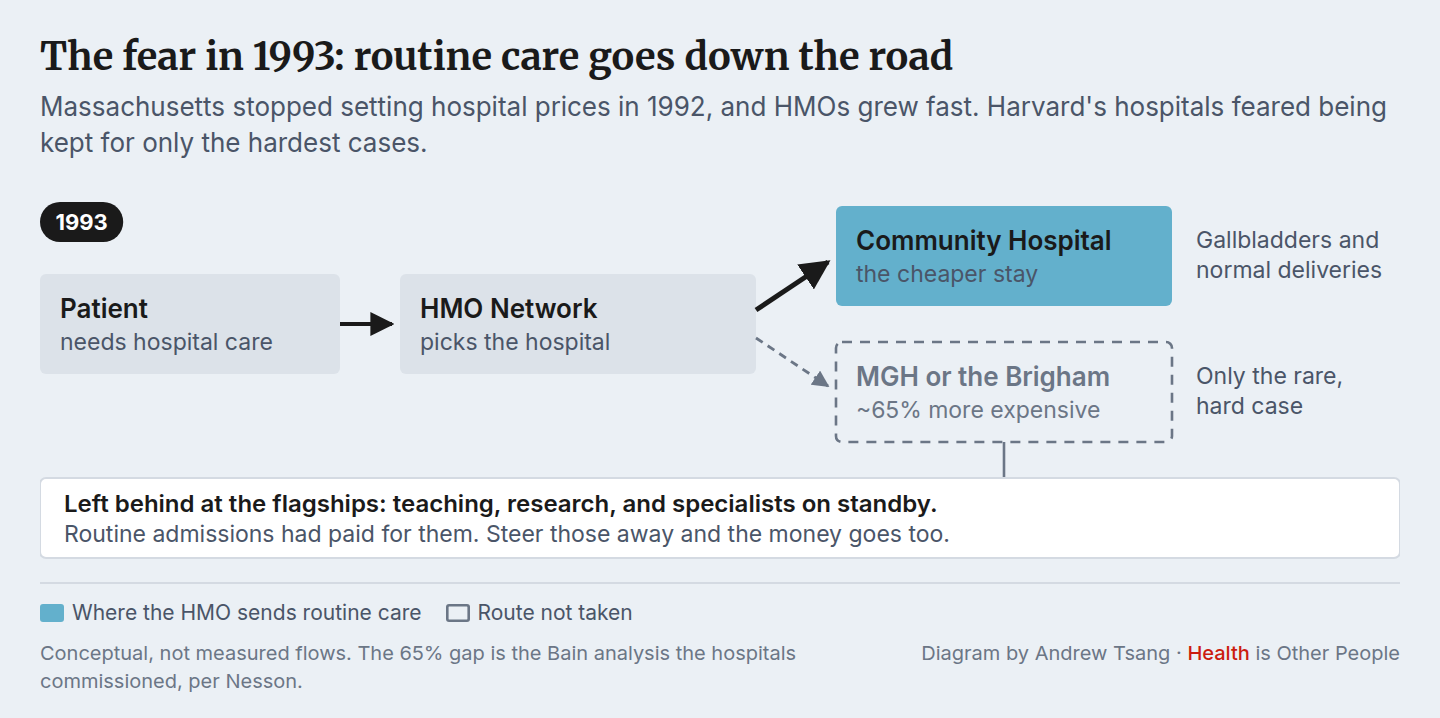
Up until 1992, Massachusetts set what its hospitals could charge. In January 1992 the state stopped, and HMOs grew fast. By the end of 1994, 40.8 percent of residents were enrolled in one, the second-highest share of any state. With the state no longer protecting their prices, hospitals that cost more than their neighbors had to protect themselves, and the only protection left was to become a hospital no insurance network could afford to leave out.
The dean’s nightmare was that five hospitals this proud would never agree and would end up in five competing systems. What worked in his favor was that the room was scared enough to consider desperate things. John McArthur, the Brigham’s board chair, remembered worrying that MGH would strike out on its own and team up with MIT. Mitchell Rabkin, who ran Beth Israel, said everyone was “in deep yogurt“ (maybe that’s how people said deep shit in those days). They feared the HMOs, and they feared each other, because an insurer that dropped one of them could send its patients to one of the other four. It was starting to look like Survivor, where the players most likely to vote you off are the ones sitting next to you, and the way to last is an alliance. If an insurer’s fallback was the hospital across town, the strongest move was to join the hospital across town.
David Matheson, the BCG consultant1 who later ran the talks between MGH and the Brigham, said “fear drove it, not aggrandizement.” But fear and ambition make the same moves, and it would take a few years to tell which one this was.
Meeting, After Meeting
Each hospital sent its board chair, its CEO, and its top doc. That’s 3x people for 5x hospitals, which is fifteen people before we add God-knows-how-many names from Harvard, the consultants, and the consultants’ lawyers. Fifteen of the most accomplished people in the field, monthly, in private, deciding the future of Boston healthcare. But put that many people with different agendas around one table, and it looks less like the mafia - and more like a group chat trying to pick a restaurant, where one person has a shellfish allergy, one won’t go anywhere without parking, and one already has a place in mind and is waiting for everyone else to suggest it.
To start the absurdity, the lawyers forbade note-taking, on antitrust grounds, which some members took personally! It may have been the only rule the room obeyed. The room swelled to thirty on a bad day, “much too many to get anything done,” the Brigham’s president, Richard Nesson, complained, and “someone was always objecting to something.” Some objected to the consultant. Some suspected the dean of trying to take over their hospitals. MGH sat across town from the other four, and they assumed it would run the whole thing anyway. Harvard put its name on these hospitals but owned none of them. The university runs on an old rule about money, “every tub on its own bottom”2 - each school pays its own way - and if Harvard didn’t run its own schools’ budgets, it certainly didn’t run the hospitals. Each was an independent corporation with its own board and endowment, and no one in the room could decide for anyone else.
One person who wasn’t in the room had already called the outcome. Samuel Thier, the president of Brandeis, had chaired medicine at Yale at thirty-seven and run the Institute of Medicine, and he spent 1993 watching the talks from Waltham. When Tosteson asked his opinion, he sarcastically said, “You’ll be lucky to get two to agree.” Within a year he would be running MGH.

Month after month they reached a unanimous stalemate - everyone agreed on the threat, then went home to a board that could say no, and nothing moved. Anyone who has sat on a big Zoom call knows how that goes - the room agrees on what needs doing, then everyone needs permission from a different boss. Hospitals can cooperate by committee for years without anyone having the power to decide for all of them. Only ownership gives someone that power, which is a big part of why American hospitals combine by buying each other.
Lunch for Two
The break came from the Brigham. Its president, Richard Nesson, knew exactly what an HMO would do to a teaching hospital, because he had built one - before running the Brigham, he was the first medical director of the Harvard Community Health Plan. He said bluntly that the dean’s coalition “wasn’t going anywhere and people were getting frustrated.” The Brigham’s board chair, John McArthur, was also dean of Harvard Business School, which made him Tosteson’s peer at the university and free to tell him no. So the Brigham had an HMO builder running the hospital and a business-school dean running its board, and both men saw the talks as a negotiation.
McArthur wanted a smaller deal. “Let’s do it ourselves,” he proposed, and he took the idea to lunch with his counterpart at MGH, board chair Ferdinand Colloredo-Mansfeld. Each man chaired his own hospital’s board, so each could carry the idea home. While Tosteson was still working on all five, he put the Harvard dream in writing - a Harvard Medical Group that all five hospitals would have to join. The written plan pushed MGH and the Brigham the other way. Their leaders met in the Brigham boardroom and agreed to go on without the other three hospitals, and in mid-June three of them - Colloredo-Mansfeld, McArthur, and MGH trustee Francis Burr - walked to the dean’s office to tell him they were out.
Two board chairmen did over lunch what 15+ people could not do in six months of meetings - and Thier’s guess turned out to be exactly right. Five hospitals would have brought more leverage, along with five boards that could each veto the deal. MGH and the Brigham brought less leverage and two chairmen who could carry their boards. Most hospital deals come together the same way, with the partners who have the fewest vetoes rather than the design that would do the most good.
They worked through the fall in private, finished the agreement over a weekend with lawyers from Ropes & Gray, and announced it on December 8, 1993. Tosteson, who had brought everyone together in the first place, learned part of it from the newspaper (the 1993 version of introducing two friends and then finding out they had brunch behind your back on Instagram). The Globe wrote that the timing made it “painfully clear how little control the dean, the medical school and even Harvard University have over the hospitals.” Harvard’s name was on the hospitals and its students were on the wards, but the decisions were made in the hospitals’ boardrooms. A dean could call the hospitals into a room. Only their boards could commit them to a deal.
And after a century of the MGH/Brigham rivalry, the announcement shocked the whole Boston healthcare world. A senior MGH surgeon told the dean he had been raised to hate three things, “the Soviet Union, the Brigham, and Yale, and now all he had left was Yale.”
The Fine Print
What MGH and the Brigham said they wanted, in the language of the announcement and the months after it:
Cut 20 percent. Take the duplication out of a combined $1.2 billion cost base, worth $240 million.
Get ahead of payment reform. In 1993 that meant the Clinton plan and managed care, both of which wanted to pay for populations rather than admissions.
Build a network. Sign up primary-care and community doctors, so patients entered the system before an HMO could steer them somewhere cheaper.
Protect the mission. Keep patient care, teaching, and research safe.
Savings led the list, because everyone benefits from savings. What the founders needed most - a stronger hand against insurers - only shows up sideways, in that line about the network, because everyone else would pay for it.
The state took it in stride. Governor Bill Weld’s administration approved the merger without a public hearing, with Charlie Baker, then his HHS secretary (and later governor himself), signing off. The attorney general approved it too, and asked only that the hospitals pass any savings on to consumers. It was the height of deregulation, and nothing in either approval said how anyone would check. By the Globe’s later account, none of the regulators imagined how Partners would come to dominate Boston healthcare. So the public got the promise that was hardest to verify, and the hospitals kept the power that was easiest to use.
What the deal actually gave them was simpler than those four promises. The first thing was a single owner, one board that could decide for both hospitals on contracts, capital, and hiring, without a cooperation agreement to renegotiate every time the world changed. The second was a single seller, one organization that met every insurer, supplier, and lender on behalf of both flagships and could say no for both of them. Together they took away an insurer’s favorite move. It could no longer drop MGH and send its patients to the Brigham, or the other way around - leave one out, and it lost both.
Harvard, which had started all this, got the dean’s nightmare after all. Tosteson had called in the five so they wouldn’t scatter into competing camps. Two left together, and within three years Beth Israel and the Deaconess had merged into a system of their own, while Children’s stayed on its own. Harvard’s teaching hospitals now sat in rival systems, bargaining with the same insurers for the same patients under the same Harvard name. And the teaching and research Tosteson had called them together to protect came through just fine. The price of ordinary care kept carrying the extraordinary work - it was just the hospitals’ market power doing the carrying, not Harvard.
Here’s the short answer to what a hospital merger merges - the negotiation. One organization selling two famous hospitals can hold out for its price. MGH and the Brigham merged out of fear of the HMOs. Within a decade the fear was gone, and the power stayed. The $240 million was another matter, because savings needed work inside the hospitals that the deal never required. Partners had its market power within a few years - the rest of the merger would take thirty.
Act II: Some Assembly Required
The Prenup
So, how does a hospital actually merge? Painfully. I’ve worked on a handful of M&A projects, and I liken the work to moving into a house together: when you both get the keys on day one, you can unload everything off the moving van - but the unpacking takes years.
Before anyone signed, the founders had already decided how much to merge. Most of what I’ve learned about those decisions comes from John Kastor, a physician who interviewed 45 people associated with Partners for Mergers of Teaching Hospitals in Boston, New York, and Northern California.3 He found that the BCG consulting team running the talks had offered the founders three structures - a holding company, a joint venture, or a full merger of the two hospitals’ assets. The more complete the union, the more the merger threatened people’s jobs, pay, and authority. A holding company, one of the consultants recalled, was “the only possible thing in Boston.”
When the deal closed in March 1994, Nesson became CEO of Partners, and Thier, who now ran MGH, became Partners’ president as well. Thier called the agreement “sort of a prenuptial”. A prenup is the contract a couple signs before the wedding, deciding who owns what if the marriage goes wrong. People sign one when they’re ready to marry but not ready to share everything. That was MGH and the Brigham - rivals for a century, marrying because they were scared, and neither willing to sign anything that looked like being swallowed by the other. So the agreement was only about ownership and almost everything else was untouched.
The ownership part was airtight. Partners became the sole member of each hospital corporation, which meant it appointed both boards and could overrule either hospital. Lawyers call that a parent company. Everything else stayed put. Each hospital kept its name, its assets, and its own doctors, and could spend half its capital budget without asking headquarters. How far Partners could reach into the hospitals’ daily work, the general counsel later admitted, had been “played down big time.”
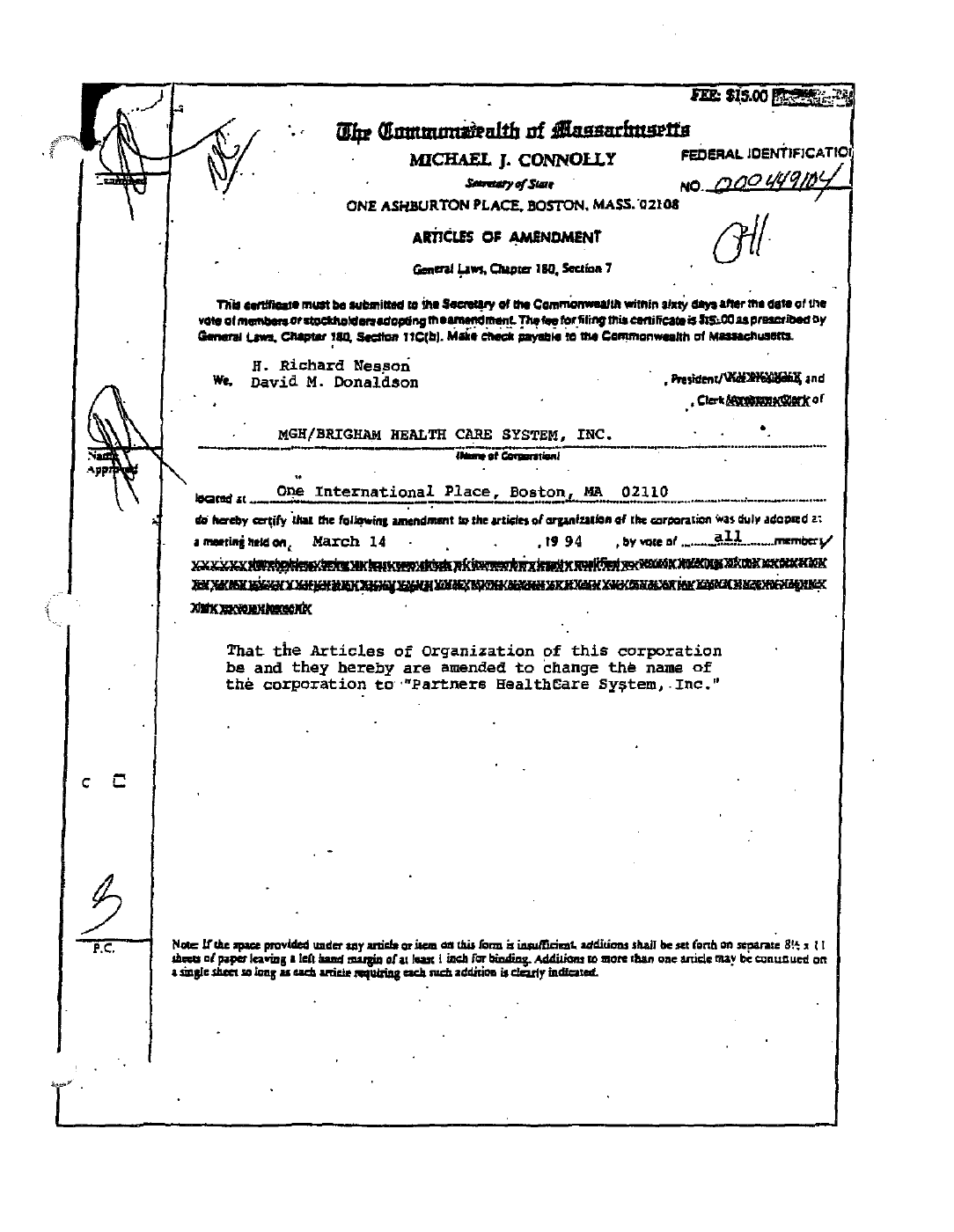
Inside the hospitals, the prenup was a legally binding maybe. The deal closed before anyone knew what it would mean for the staff. That’s normal - plenty of people find out the couch doesn’t fit in the den only after they’ve moved in. In due diligence, dealmakers study what the deal is worth. What they can’t learn is who will run surgery, because that only comes out once you put the two departments in a room. On one of my client M&A projects, when we raised a stink about how hard the merger was, a senior exec told us, more or less, “that’s what you get paid for.” The board made the deal - the staff made it work.
The prenup left those questions to the people running Partners - and the most formidable of them was Thier. Colleagues described him as a man who could intimidate a room and then charm it, and when he took over MGH, the reaction at the Brigham was “That’s it; we’re dead. Sam’s too good. No one can manage him.” His instruction to the department chiefs was as blunt as merger instructions get.
“I’m a physiologist, not an anatomist. Make it work, or we’ll have one chief.”
Physiology is how the parts of a body work together, and anatomy is where they sit. Thier didn’t care whose name stayed on each department as long as the two worked as one. If the chiefs couldn’t arrange that themselves, he would - by keeping only one of them. That was the prenup’s whole plan for the medicine. It didn’t merge the departments. It told the departments to merge themselves, and put their jobs on the line if they didn’t.
Partners needed a headquarters that could govern both hospitals without belonging to either. It set up on the eleventh floor of the Prudential tower, roughly halfway between the two, above a shopping mall.4 Neutral ground was the price of a merger of equals, since neither hospital would take orders from an office inside the other. But an office with no patients and no doctors has legal power and not much else. Partners could send instructions down from the eleventh floor, and each hospital could wait them out.
Most hospital systems today still look like Partners on its first day. A 2021 study of 377 American hospital systems found that 82 percent “remain relatively decentralized,” operating “largely as holding companies”. In practice, the system signs the insurance contracts, borrows the money, and buys some of the supplies, while each hospital keeps its own doctors and its own way of practicing. Mass General Brigham’s hospitals still keep their own medical staffs. That’s the prenup, made permanent, and it caps what a merger can save. Most of the twenty percent Partners promised would have to come from how care is delivered - the one thing the prenup left exactly where it was.
The Missing Binder
So where was the $240 million supposed to come from? The holding company bet that the back office could do the work without touching the medicine. Streamlining the procurement and IT would cut the cost of running two hospitals, and the billing office would collect the higher prices that Partners could now command. These were the only parts of a hospital that headquarters could actually command.
The industry even has an order for carrying out hospital mergers. A 2025 American Hospital Association integration guide says some processes “must go first to keep the organizations running, including human resources, finance, revenue cycle and supply chain.” Payer contracting and management structure can run alongside them, and “clinical program design and physician alignment” go last. In practice, each side arrives with its own version of everything - two finance departments, two HR teams, two purchasing offices, two computer systems. The functions that have to work on day one (payroll, the bills, the supply closet) go first. The ones where doctors practice go last, because that’s the part the two sides still disagree about. It’s moving in together all over again - you hook up the Wi-Fi on day one and argue about where the couch goes for the next year.
Mergers are mostly opaque from the outside, but Massachusetts makes the big ones show some of their work. When Beth Israel Deaconess (itself the 1996 merger of two hospitals from Tosteson’s room) combined with Lahey Health in 2019 to form Beth Israel Lahey Health (BILH), it had to give the state’s Health Policy Commission its 32 pre-merger design teams, and sixty days after closing it reported to the Attorney General what it expected to save. In the savings report, seven workstreams got numbers, from supply chain to the physician network, while primary care, cancer, and orthopedics were named and set aside.
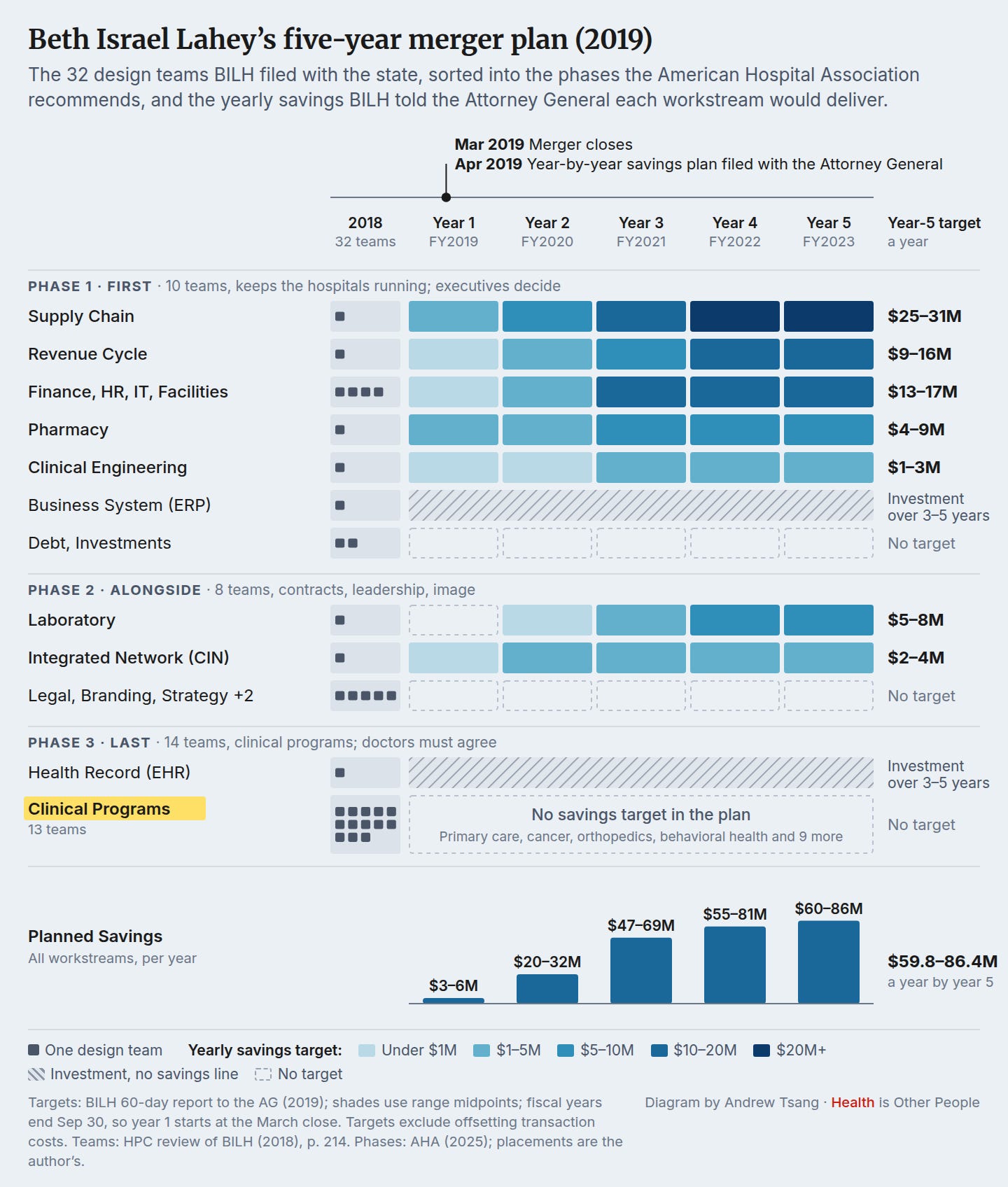
Partners never had to file anything like that. Massachusetts didn’t make merging hospitals show their work until 2012, and if Partners wrote a plan down, it’s been lost to history, most likely in a three-ring binder somewhere (this was long before anyone kept these things on SharePoint).
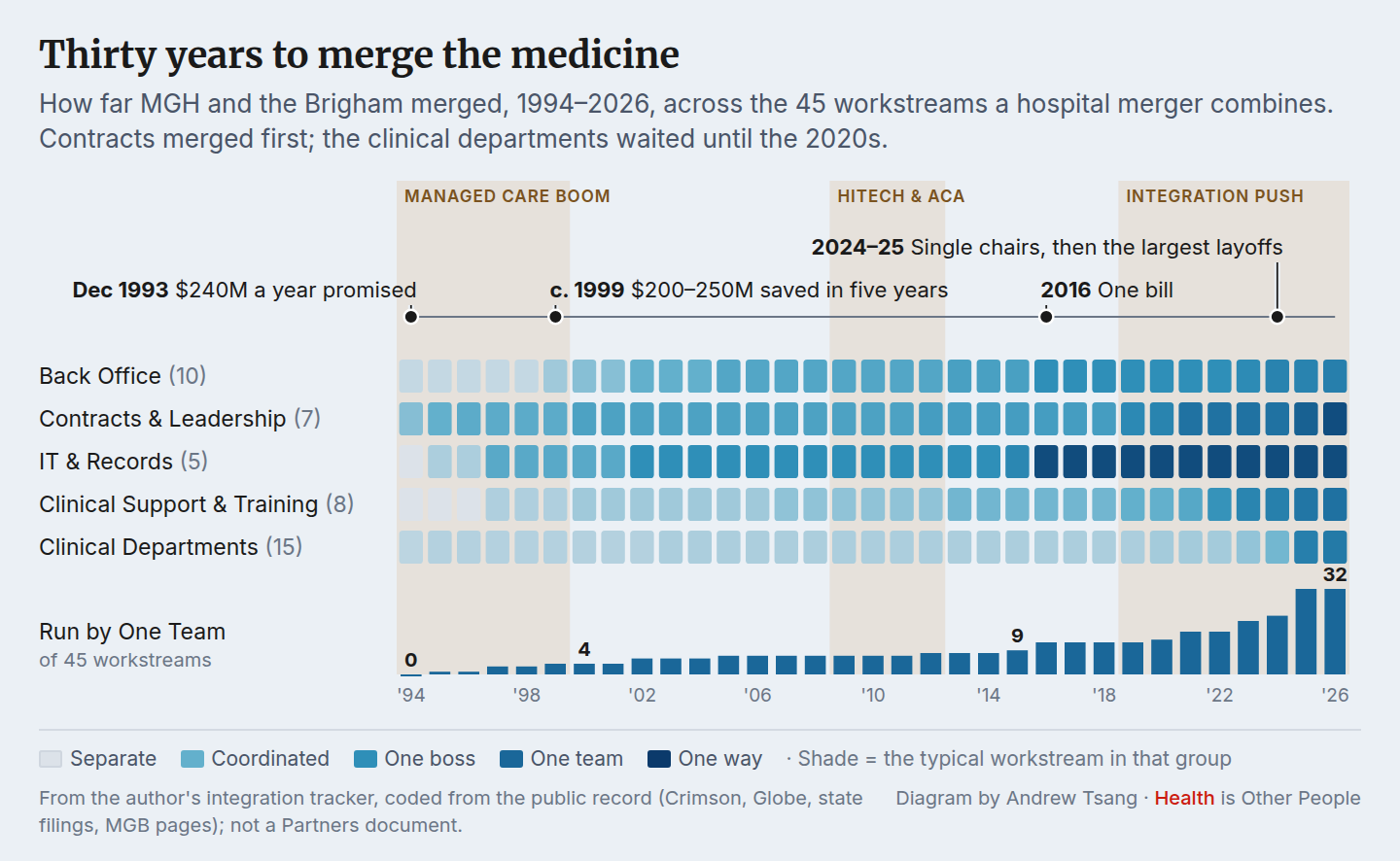
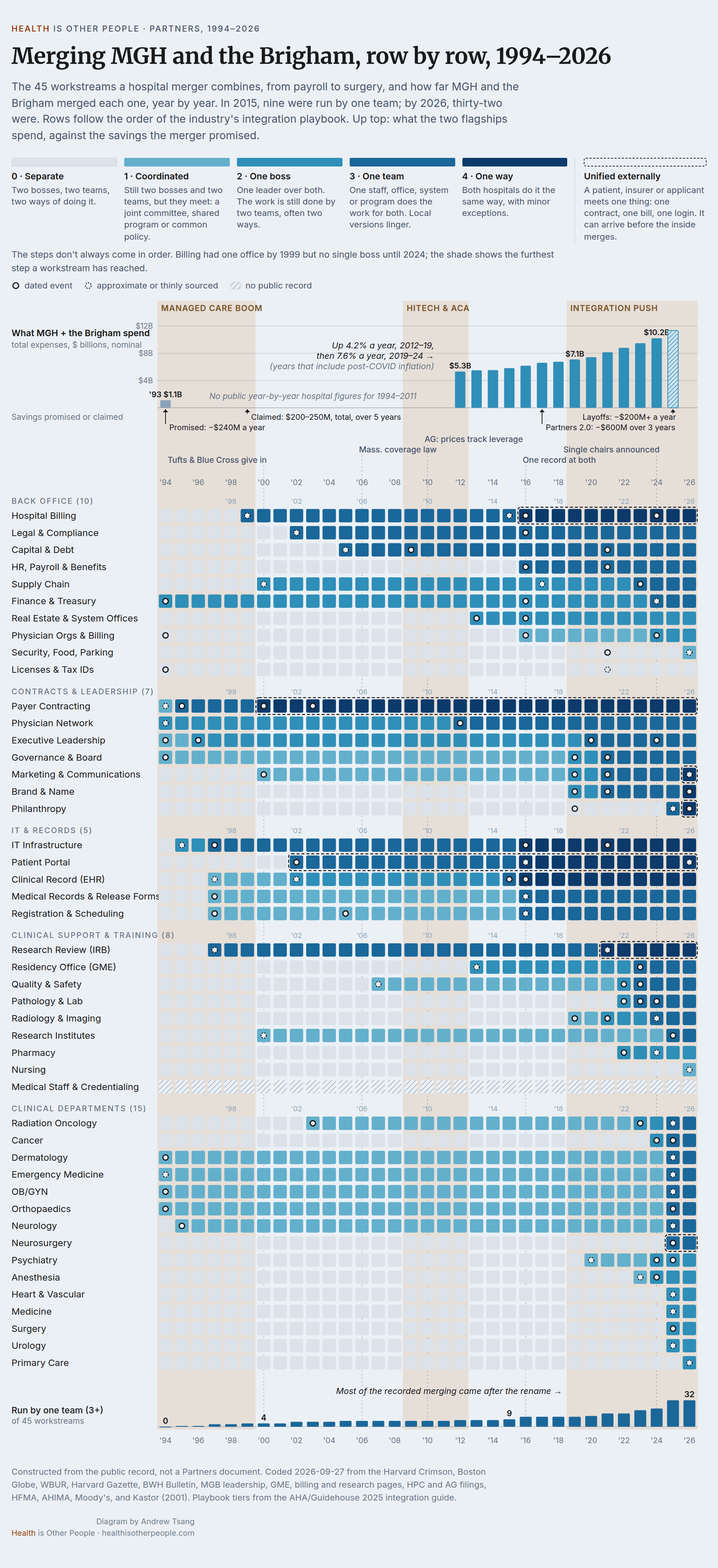
So I rebuilt one - a tracker of forty-five workstreams, from payroll to surgery, taken from the industry’s playbook and filings like BILH’s. What happened in each row, year by year, comes from the public record: Kastor’s interviews, the Crimson and the Globe, state filings, and Mass General Brigham’s own web pages. The integrations I’ve worked on took a few years. Partners’ still hasn’t finished.
Small Businesses, Shared Lobby
Business leaders often overlook that the back office actually runs on the medicine. Admin looks like overhead - the obvious place to save when two organizations combine - and in most industries, it is. But in a hospital, every back-office function sits downstream of a clinical decision. Purchasing buys the knee scopes the surgeons choose. The computer systems encode how doctors order and chart. Billing can only charge for what the clinicians wrote down. So every back-office saving Partners wanted would have to be negotiated with the doctors anyway, just one step removed. Keeping the medicine separate got the deal done, and it put the savings behind the medicine.
And the people who make those clinical decisions don’t answer to headquarters. It turns out a hospital is a federation of small businesses that share a lobby.
Department chiefs run their departments like firms. They decide which programs to build, whom to hire, which standards to hold, and whose research gets lab space, and the department’s reputation is as much theirs as the hospital’s.
Referrals are relationships. A primary-care doctor sends patients to the specialist she trusts, often someone she trained with, and those paths take years to build. Headquarters can’t reroute them with a memo.
A chief of surgery is closer to a head of state than a division manager. Changing the department means negotiating with the chief, the surgeons, and everyone whose career runs through them, which makes it diplomacy more than management.
Names outlast the people in them. A named chair carries a donor family’s gift into the next century, and residents carry their program’s name for the rest of their careers. Fold two programs together and you’re renegotiating both, which is why integrating a hospital gets political before it gets administrative.
It’s easy to read that list as ego - and some of it is. But each arrangement is also how care gets delivered (who operates, who trains the residents, which specialist a patient ends up seeing).
On an org chart, you might assume merging looks simple. A board can put two purchasing departments under one manager, or pick one set of clinical order sets for both hospitals. But you know what happens when you assume. The surgeons have to accept the new supplies, the nurses have to relearn order sets they could once fill in half asleep, and the chiefs have to agree on how to train residents. The hardest part of mergers is change management - and trainings and comms aren’t enough. Even getting physicians into a training session could mean fighting a fully booked clinic schedule, a curriculum that had to be rewritten, and the rules for continuing-education credit. Every hour a doctor spends in training is an hour of patients not seen, so the closer a change gets to clinical work, the more likely it is to be put off. And the two sides of a merger aren’t built the same. I’ve seen a bigger organization need ten approvals for what a smaller one could settle with one person, while the smaller one had no one free to take the work on. That’s a different problem from a chief protecting a title - it’s two cultures moving at different speeds.
That splits a merger’s savings in two. Some come from size: buying in bulk, one treasury office, fewer managers, cheaper borrowing. Hospitals can get many of those without merging, through a group purchasing organization or shared services, and executives can order the others early. The rest come from agreement: one supply list, one chart, one way to bill, one department. Those need the doctors - which makes them the only savings a merger can claim.
Who runs a hospital, then? The board owns it and executives manage it, but the doctors decide how patients are treated, and the departments, referral paths, and training programs are built around those decisions. That leaves the meaningful work of merging in the hands of the clinicians - supplies, bills, and charts all change only when the doctors agree to work one way.
Doctor’s Orders
Partners ran into the doctors in four places, each one closer to the medicine than the last - the supply closet, the billing office, the computer systems, and finally the clinical departments. Each slice below comes straight from the tracker.
Sutured Together
Supplies should have been the easy part. Buying is the one job a headquarters is built for - add up both hospitals’ orders, call the vendors, and bargain. Hospitals have pooled their purchasing for decades (group purchasing organizations exist to do exactly that). Two hospitals buying the same gauze pay less buying it together. So Partners started stitching its hospitals together where anyone would, in the supply closet.
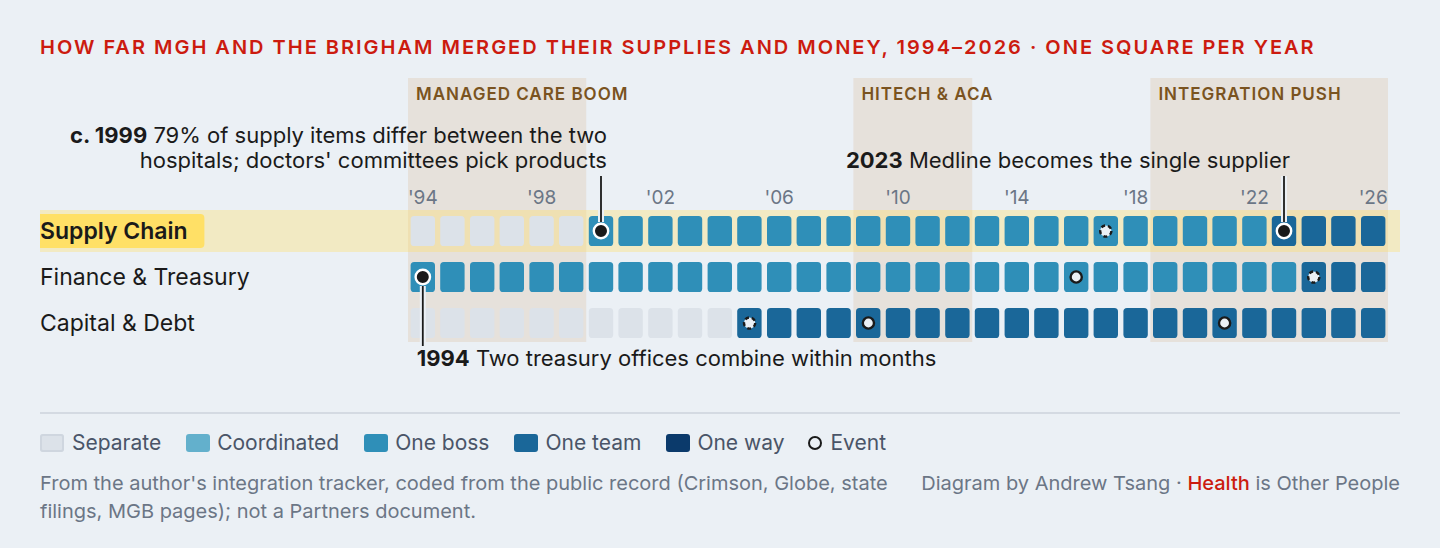
The trouble was that the two hospitals weren’t buying the same gauze. Partners’ purchasing director, John Gaida, found that 79 percent of the two hospitals’ supply items differed. That wasn’t sloppiness. Each hospital’s catalog had been built over decades from what its own surgeons trained on, asked for, and got used to, down to the brand of suture. A surgeon who has tied thousands of knots with one brand knows how it slips, holds, and breaks, and a purchasing spreadsheet has never tied a knot. Gaida spent months matching the lists line by line before he accepted that he couldn’t make those calls himself.
So he handed them to the people who could. He set up clinical committees, chose doctors with strong product preferences to lead them, and set the committees competing on savings. The doctors who knew the products could tell a difference that mattered for patients from a habit they could afford to give up, and now they owned the savings as well as the choice. The hospitals standardized sutures, and Gaida reported that the distributor Partners chose saved about $13 million against an annual budget of $50 million. What they ended up with was a standard with exceptions, the only kind surgeons accept.
Gaida went in to negotiate with vendors and ended up negotiating with surgeons. Headquarters could bargain for a price, but a price only saves money on an item both hospitals agree to buy, and only the surgeons could make that list. And sutures were the cheap end of the catalog. The implants and devices surgeons train on make up 40 to 60 percent of supply spending, and asking whether two hip implants are equivalent asks far more of a surgeon than asking about two sutures. The savings only a merger could deliver were in the operating room, one surgeon’s preference at a time.
The Check Is in the Mail
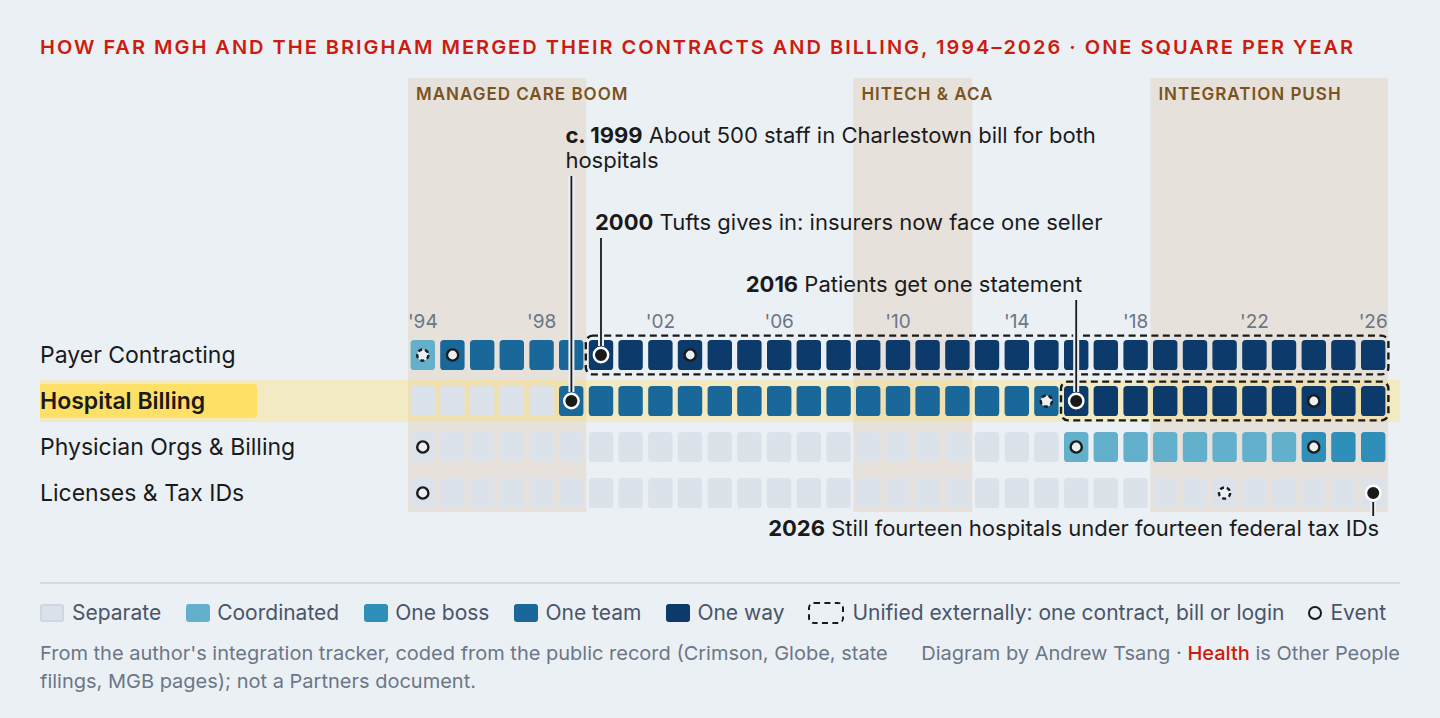
Supplies were the cost side of the bet. Billing was the revenue side - one negotiator would win better contracts, and better contracts would bring in more money. Turning a contract into cash is the job of the revenue cycle, the long chain that runs from registering a patient and checking their insurance, through coding what the doctors did, to sending the claim and chasing the payment. Partners moved that job early. By Kastor’s account, by the end of the decade about 500 staff in Charlestown, away from both hospitals, handled billing and other financial work for MGH and the Brigham.
A hospital billing office doesn’t just receive payments - it hunts them down. A contract sets what an insurer owes for each kind of care, but the insurer pays one claim at a time, and each claim has to prove what happened to one patient (who they are, what coverage they have, what the doctors did), which is why I think of the claim as where hospitals and insurers actually meet. By the late 1990s insurers were “managing their cash more efficiently” - in Kastor’s gloss, “a euphemism that means they are paying more slowly” - and every incomplete record gave them another reason. When revenue fell short, the hospitals blamed the billing office, and the billing office blamed the incomplete or inaccurate information the hospitals sent it. Insurers used the errors to reject claims and delay payment while the two sides argued about whose fault it was. An insurer doesn’t care which hospital sent the wrong data - it just doesn’t pay.
Revenue cycle is my home turf. After the deal, the bills still go out, but the inside is a mess. Whole categories of accounts have sat in one status or bounced between teams while staff tried to establish which record, or which organization, governed them. The error was made somewhere else, but it shows up in the billing office as the wrong insurer, the wrong balance, or a payment the account doesn’t show. Fixing it means finding people several teams upstream and proving which system is right when each one is right by its own definitions.
The Charlestown billing office collected plenty. But what the shared office couldn’t do was make the hospitals’ differences go away. Putting the billers under one roof gave those differences a single address, and every place MGH and the Brigham registered, documented, or coded a patient differently arrived there as a rejected claim or a late payment, with a dollar figure attached and no one in the building who could fix it at the source. The negotiators won the price in a day, but the revenue cycle offices grew to reconcile the hospitals’ differences. Patients didn’t get one bill until 2016, when the shared Epic record reached MGH. It wasn’t until Partners got one chart that the revenue cycle smoothed out.
Permanently Temporary
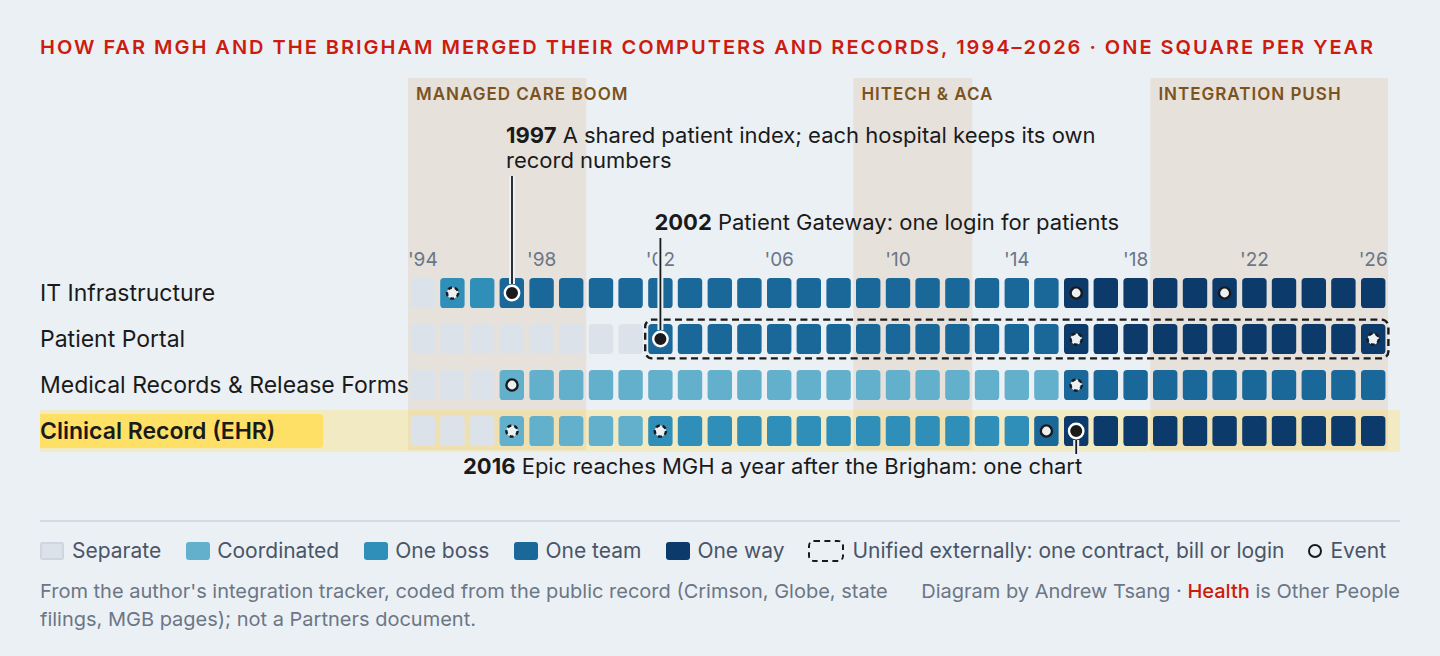
The claim is built from the chart, and the chart turned out to be the hardest thing to merge. Putting two organizations on one system sounds like an IT project, and outside healthcare it mostly is. In a hospital the main system isn’t a back-office tool. The electronic health record is where doctors and nurses order, chart, and decide, so changing it changes how medicine gets practiced. Even merging the two IT departments made more work before it made less. When John Glaser, Partners’ first chief information officer, began combining them in fall 1995, about 300 people ran the two hospitals’ systems. Within two years there were more than 500, and the budget had jumped from $42 million to $66 million.
Part of the challenge is what’s inside a health record. It’s clinical choices written into software: which questions to ask, which orders to offer, what a doctor must enter before signing. Even a familiar word turns into a negotiation. Take “discharge”. A patient might move from the emergency room to observation, then to an inpatient bed, then home. Before two hospitals can report one discharge count, someone has to decide which of those moves counts, and whatever they decide becomes an instruction in the software (a required field, a shared report, a rule about what happens next). Multiply that by every term two hospitals define a little differently, and a records merger turns into thousands of small agreements about how to practice. Then everyone has to live with them. If you’ve ever switched from Android to an iPhone, you know the feeling. The new one works fine, but for weeks every habit you have is wrong. Now imagine that for the system a nurse uses to give medication at 3 a.m., across thousands of people, with patients in the beds the whole time.
Where those agreements aren’t reached, people work around them. Anyone who has used the same software for years knows its shortcuts, and when the new system can’t give staff an answer the old one did, they quietly keep a spreadsheet on the side or slip back into the old application. It’s called shadow IT, and if you’ve worked a white-collar job, you’ve probably kept some yourself. Much of the early part of my career was spent walking around health systems finding it. The spreadsheet becomes permanently temporary, because no one can retire it until they figure out where its work will live in the new system. Until someone does, the organization pays for the new system and the old one, and staff check both.
At Partners, the 1990s merged the plumbing (networks, workstations, a shared patient index). The two flagships kept separate clinical charts until a single Epic record arrived, at the Brigham in 2015 and at MGH in 2016, twenty-two years after the merger. Partners’ own estimate grew from $600 million to $1.2 billion as the project’s scope expanded, and my idol Atul Gawande,5 writing about it in the New Yorker, put the full cost at $1.6 billion, because he also counted the patient revenue lost while clinicians slowed down to learn the system. The software itself cost under $100 million - less than a dime on the dollar. Nearly all of the money paid for clinicians’ time, which is what it costs to get two hospitals to practice one way. And even one chart could only hold the agreements the departments were willing to make.
The Bleeding Departments
Two of the founders’ promises collided in the clinical departments - cut the duplication, and protect the mission. Cutting duplication meant combining departments. Protecting care, teaching, and research meant not breaking the departments that did that work. At MGH and the Brigham, those were the same departments.
The departments that did combine early each had a reason that made it easy:
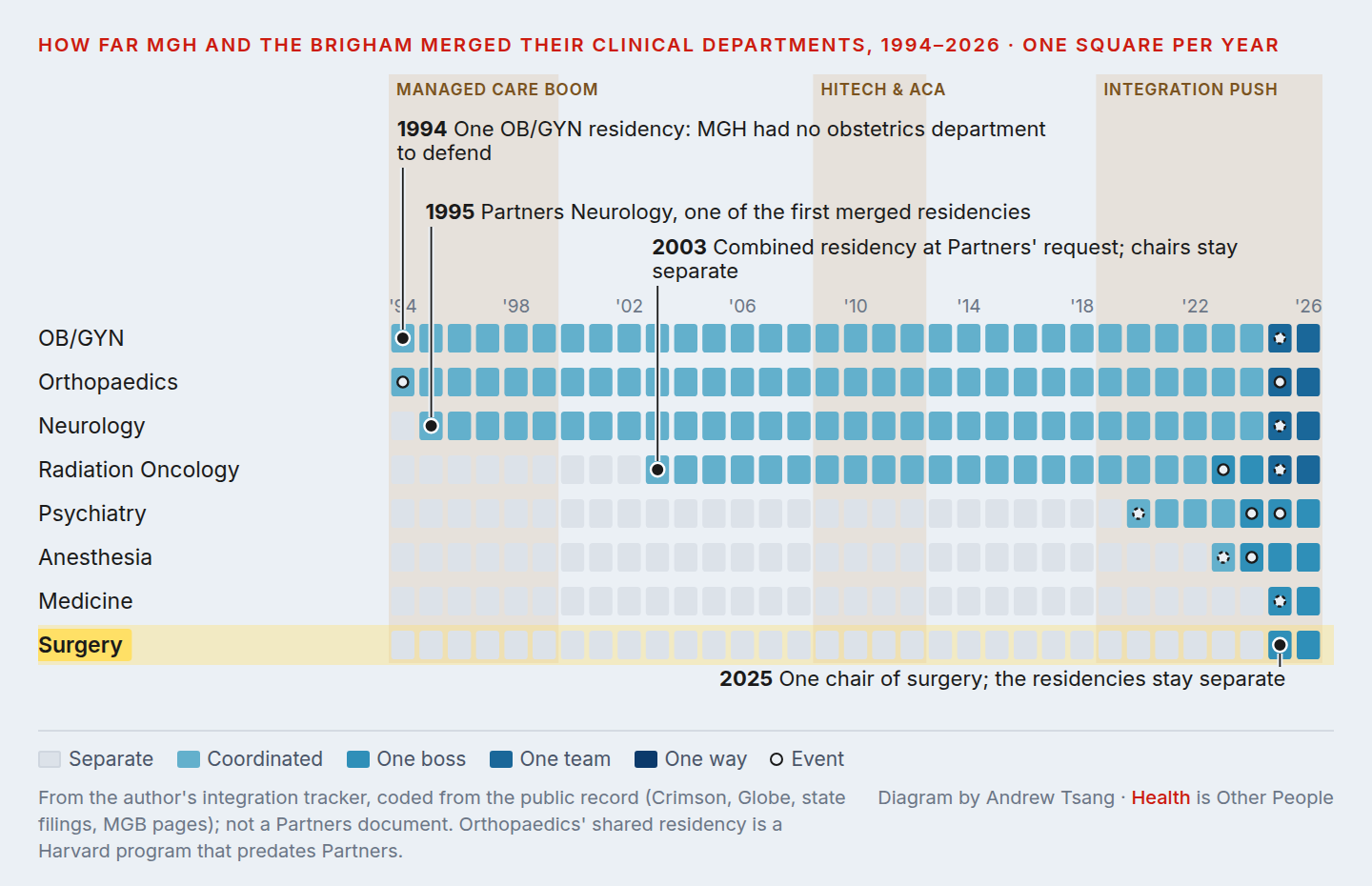
Obstetrics and gynecology - nothing to merge. MGH didn’t deliver babies until 1994, so when the two hospitals formed an integrated OB/GYN residency that year, there was no MGH obstetrics department to defend. It was a merger of one.
Psychiatry - a shared deficit. Psychiatry lost money almost everywhere (”a national disaster because of low reimbursement”), and as one Partners leader put it, the two programs came together “because each was bleeding.” In 1998 Partners recruited Gary Gottlieb to run psychiatry across its hospitals, with the chiefs at MGH and the Brigham reporting to him.6 Each hospital kept its own chief, so it stayed two departments with one coordinator until 2024, when the system named a single chair.
Neurology and orthopedics - good timing. In neurology, the chairs got along and combined residency training. In orthopedics, both chiefs happened to retire at the same time, so Partners recruited one chairman to run both departments, with a deputy at each hospital (the rare merger where the org chart solved itself). Combining two departments means one chief instead of two, so it moves fastest when a chief leaves. Beth Israel’s Mitchell Rabkin had a mnemonic for this - the first two letters of merger are m and e (what is going to happen to me?).
Surgery - no opening at all. David Torchiana, an MGH cardiac surgeon who would later run Partners, asked fifteen colleagues about combining the surgical residencies and couldn’t find one who wanted to. The two programs trained surgeons in opposite ways. At the Brigham, residents largely ran the services and faculty rotated through. At MGH, individual faculty kept direct control over their own patients, and the residents came to them. It’s the difference between residents running the kitchen and residents apprenticing to one chef. Both surgery departments were making money, so nothing forced the choice.
Thirty years in, the training is still mostly two. In 2025, twenty of the system’s thirty-five residency programs still carried one flagship’s name, and the two anesthesia programs still hadn’t agreed on what to call the specialty (one is “Anesthesiology,” the other “Anesthesia”). The system’s “Enterprise Pathology Laboratory Handbook“ still asks which hospital you’re in before it shows you a test menu, because the two flagships’ menus differ by about a hundred tests. A lab can’t have one menu until the doctors agree on one.
Medicine merges when something squeezes it - a deficit, a retirement, a department with nothing to defend. Without a squeeze, two working ways of practicing stay two. Surgery felt no squeeze at all, and neither did most of the departments that made the two hospitals famous.
Boxes in the Garage
Partners had the power to force the other departments together. Its board could overrule either hospital, and Thier had told the chiefs he’d keep only one of them. It rarely used either. Nothing was squeezing the departments it would have had to force. They were the ones paying the bills, and no executive wants to be remembered as the one who reorganized the golden goose.
The one thing Partners could build without touching either hospital’s medicine was going well. That was the network. Under managed care, the HMO decided which hospital a patient went to, usually through the patient’s primary-care physician, who acted as the gatekeeper for referrals. Whoever held the PCPs held the referrals, and whoever held the referrals held the patients. So Partners set out to sign up the doctors before the insurers could steer them. Nesson recruited Ellen Zane, a community-hospital executive, to build Partners Community HealthCare, or PCHI. She started with a secretary and drove out to doctors’ offices one at a time. The doctors had their own reasons to worry about HMOs, and negotiating insurance contracts was one more job they were happy to hand off.
It worked. By 1999, more than 900 doctors had given PCHI the right to negotiate their HMO contracts, covering about 200,000 patients. These were at-risk contracts, where the doctors got a set amount per patient and gained or lost depending on what care cost.7 And when those patients needed a specialist, Zane told Kastor, about 70 percent of the referrals went to MGH or the Brigham. The HMOs had planned to use primary-care doctors to steer patients away from the expensive flagships. Partners signed up the doctors first, and the steering ran the other way. Of the four promises, the network was the only one Partners kept by building something new, and it was the one aimed at the insurers.
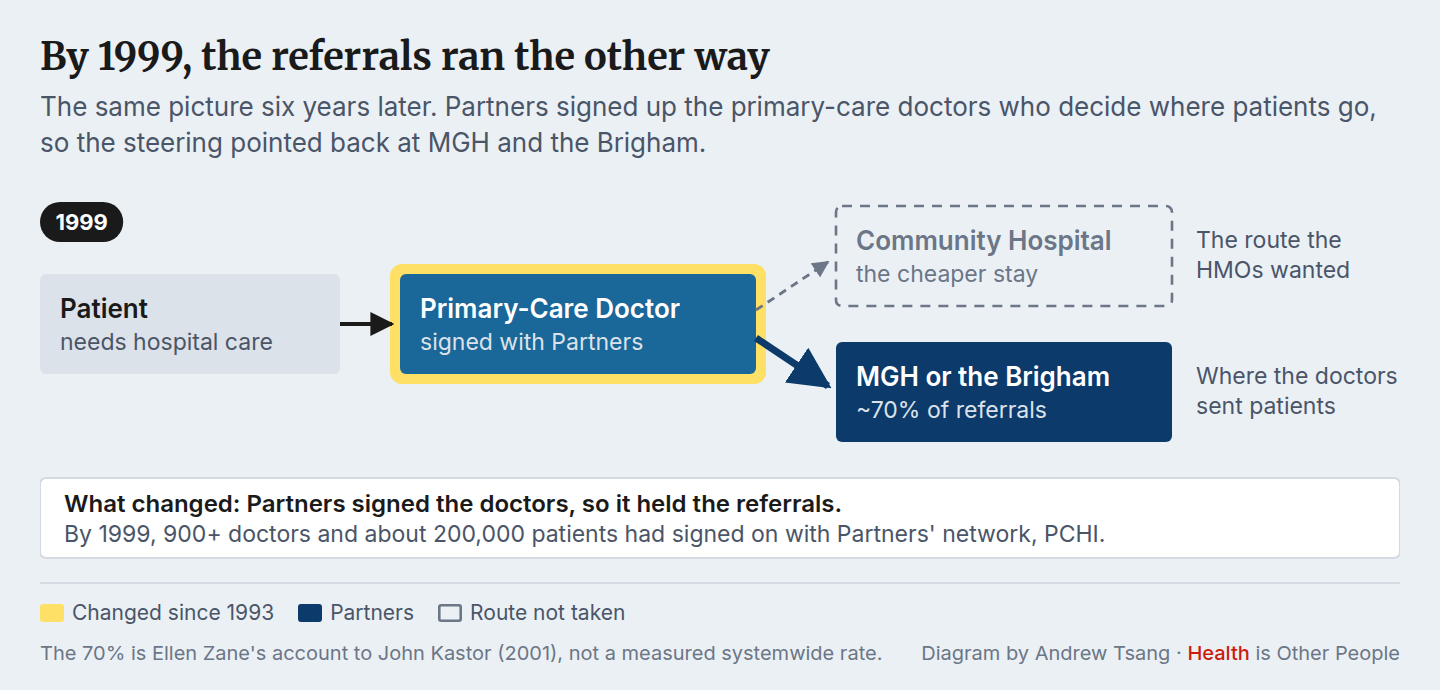
With the beds full and no department in the red, the case for disrupting departments that worked was hard to make, and keeping them intact protected the revenue Partners had been formed to defend. The outside paid well enough that the inside could wait. As long as the rent’s paid, the boxes in the garage stay taped.
That’s how a hospital actually merges. The side that faces outward merges first - one owner on day one, one seller across from every insurer within a few years - and that part pays right away. Everything inside merges only as fast as the doctors agree to work one way, and doctors mostly agree when something squeezes them. Partners was built to beat the insurers, and it never needed the medicine merged to do it. On the tracker, by my reading of the record, only nine of the forty-five workstreams were run by one team in 2015. As long as nothing squeezed the whole system, the rest could wait - and it did, for about twenty-five years.
Act III: Who Picks Up the Tab
Two in three American hospitals now belong to a health system built by mergers. Look around one and you can still see the scars: two badges for certain buildings, two titles for the same job across orgs, a spreadsheet kept alive because the new system can’t do what the old one did. Every merger I’ve worked on was sold to its board on the same two promises - more bargaining power with insurers and savings from sharing everything else. The research on hospital mergers keeps finding higher prices and little change in quality. When Evanston Northwestern, outside Chicago, bought Highland Park Hospital in 2000, its own executives counted “some $24 million of revenue enhancements” from renegotiated insurer contracts within a year, and the FTC later ruled the deal anticompetitive. Revenue from a merger needs one signature. Savings need thousands of people to change how they work (and many, many expensive meetings). That is what a hospital merger merges - the negotiation right away, the back office slowly, and the medicine last, if ever.
Two Hours’ Notice
Against a promise of $240 million, Partners later claimed $200 to $250 million over five years, almost all of it from administrative consolidation, in offices patients never see. That is roughly the number on the page, and it left the hardest savings untouched.
The largest savings were supposed to come from the medicine, and for twenty-five years no one pushed to collect them, because the leverage made pushing unnecessary. Most of the duplication the founders promised to cut was in the clinical departments: two departments of surgery, two of medicine, two of nearly everything, each with its own chief, like a hospital Noah’s Ark. According to the Globe, the system didn’t seriously attempt to integrate clinical services until 2019 - the year it dropped the Partners name. In 2021 CEO Anne Klibanski described the organization her predecessors had run for a quarter century as “really a holding company,” one that owned two great hospitals without combining the care inside them. The cheaper, better-coordinated care the merger promised patients never had a chance to show up.
Clinical savings are hard to collect because every change to care has to get past the people who give it, and doctors aren’t the only ones who can say no. Suppose a new protocol for sending patients home adds fifteen minutes per patient: ask about a ride home, safety at home, whether the patient can manage their medications. At MGH, where nurses aren’t unionized, that is a manager’s decision. At the Brigham, where about 4,000 nurses make up the largest nurse bargaining unit in Massachusetts, it is a union negotiation. Every difference that makes each hospital what it is turns into a meeting, and every meeting takes people away from patients. The $240 million on the founders’ list assumed those meetings cost nothing.
The doctors held the most power in those meetings. The Brigham’s chief of surgery watched Beth Israel Deaconess force its own integration and struggle, and concluded that pushing harder at Partners would have been a mistake. Partners executives told the Globe that consolidating would have “inconvenienced patients and driven away top physicians.” For twenty-five years, the chiefs outlasted every plan.
What finally moved the medicine was what moves any department - a squeeze, this time on the whole system. MGB closed fiscal 2023 with an operating loss. Labor had grown more expensive after the pandemic, sicker patients were staying longer while insurers still paid by the admission (a hotel paid per check-in while the guests stay an extra week), and that fall Dana-Farber ended its decades-long cancer partnership with the Brigham. Jack Connors, the former Partners chairman, told the Globe there was “more reason to do it now than there ever has been,” because “the motivation now is survival.” Fear had built Partners in 1993, and thirty years later fear was finally merging the medicine.
In March 2024, Klibanski announced that corresponding departments at the two hospitals would come under single chairs, cutting the number of clinical departments roughly in half, to eighteen, with the stated aim of easier access for patients and more collaboration in research and teaching. It was musical chairs, and department heads got two hours’ notice before the music stopped (roughly half of them were about to become former chairs). One physician told executives that many colleagues felt “unheard, devalued, disempowered, and unseen,” and at least eighteen primary care providers left for Beth Israel Lahey. Michael Jellinek, a former chief clinical officer of Partners, called it “an earthquake in the hallways.” After twenty-five years of asking the chiefs to cooperate, the system settled the question by appointment. The medicine was the last thing the merger merged, and the only part that cost the hospitals their own people.
The squeeze reached the back office next. In February 2025 MGB began the largest layoffs in its history, aimed at administrators and managers, after executives said parts of the system had as many as fifteen layers of management (about twice what high-performing organizations use - stacked as floors, it would top Partners’ old eleventh-floor office) and duplicate management roles. Thirty years after the founders promised to take out the duplication, a budget shortfall was finally taking it out.
Here is every workstream, all thirty years of it.
“You Are Not Partners”
While the inside waited, the managed-care storm the founders had braced for was blowing itself out. By 1997 the public had turned on managed care, and Congress was debating a patients’ bill of rights. In January 2000 the state put Harvard Pilgrim into receivership. Harvard Pilgrim was Nesson’s old HMO.8 Its chief executive by then was Charlie Baker, the same official who had signed off on Partners (Boston healthcare is a small town with very tall buildings). The insurers the founders had armed themselves against were now the ones in trouble.
The leverage outlived the threat. Late in 2000, Tufts Health Plan refused a Partners price increase and gave in within days. People choose a hospital for the worst day they can imagine, and in Boston that meant MGH or the Brigham. When a Beth Israel executive asked Tufts’s chief executive why Beth Israel Deaconess couldn’t get the same rates, the answer was “You are not Partners.” In 2001 Partners won the same kind of increase from Harvard Pilgrim, which meant Nesson’s old HMO was now paying his new system’s prices. Once the threat was gone, the power built to defend the hospitals became the merger’s return, collected in price.
For MGH and the Brigham, it was a good deal. The dean had wanted all five Harvard hospitals in one group, and the five couldn’t agree in a room. Had they managed it, one negotiator would have held even more of Boston, and the parent would have faced five sets of chiefs instead of two. The founders got the most leverage available without disturbing the medicine that people admired. Judged the way a board judges an investment, Partners paid off.
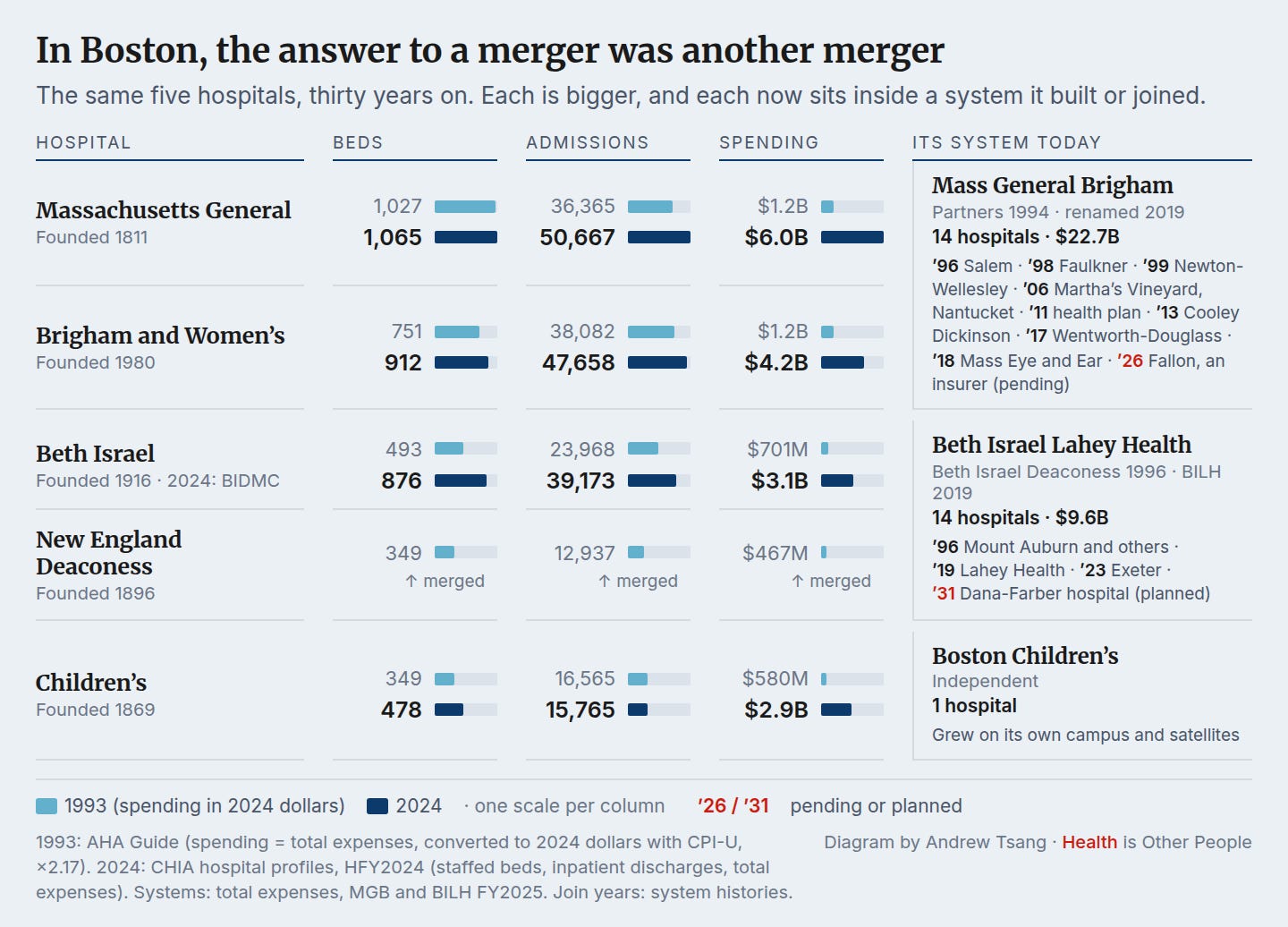
The rest of Boston drew the same conclusion. Beth Israel Deaconess, formed in 1996, was in the Globe’s words a response “at least in part” to Partners. It grew into Beth Israel Lahey, the rival that took those eighteen primary care providers and the partner Dana-Farber chose when it left the Brigham. Children’s stayed independent and did well on its own, which suggests a famous hospital already holds leverage (the attorney general’s 2010 report put Children’s among the highest-paid hospitals in Boston). In Boston, the answer to a merger was another merger.
MGB’s latest deal is with an insurer. In January 2026 it agreed to acquire Fallon Health, a Worcester insurer with about 140,000 members, mostly in Medicare and Medicaid, and fold it into its own health plan, which already covers about 405,000 people. An insurer the system owns can’t threaten to leave its hospitals out of the network. Partners was built so that insurers couldn’t dictate its prices, and thirty years later it is buying one (if you can’t beat them, buy them - and if you can, buy them anyway).
What We Ask Them to Become
The prestige was easy to see. What Massachusetts got for the price was harder to find. In 2010 the Attorney General found that Massachusetts hospital prices were “not correlated to quality“ and were “correlated to market leverage,” with Partners’ hospitals among the highest paid. In 2022 the Health Policy Commission found that MGB’s commercially insured primary care patients accounted for $293 million in spending growth above the state’s benchmark from 2014 to 2019, more than any other provider’s, and made MGB the first organization ever required to file a PIP - the same thing a manager hands an employee who is about to get fired. The reputation is earned for the world, in research grants and Nobel Prizes, and the price is paid in Massachusetts, in premiums.
Even the people who built Partners didn’t expect it to make care cheaper. “I don’t ever remember anybody suggesting that if we merged, healthcare would be cheaper,” Connors told the Globe. If MGH and the Brigham, with more money, talent, and patience than almost anyone, got their leverage within a few years and their medicine in thirty, the merger announced next month will do no better. I don’t think anyone in this country really knows how to merge a hospital.
Hospitals keep merging because we ask them to. Academic medical centers like MGH and the Brigham are the R&D arm of American medicine, and R&D doesn’t pay the way a knee replacement does. The hospitals do very well for themselves, but grants and donations cover only part of the research, training, and readiness we expect from them, and we leave the rest to what they can charge for everyday care.
That work has produced a lot of medicine you already know. The Brigham’s Nurses’ Health Study, running since 1976, tied trans fats to heart disease, which put them on every nutrition label and changed how food is made around the world. Operating rooms around the world follow a pre-surgery checklist from a team led by Atul Gawande - a Brigham surgeon - and in its first trial deaths after surgery fell by more than 40 percent. In 2024 MGH put a genetically edited pig kidney into a living patient - a first step toward shortening the line for the more than 95,000 Americans waiting for a kidney.9 MGH has been doing this kind of work for two hundred years, and the Brigham for more than a century.
The people travel even farther than the research. Mass General Brigham trains more than 2,400 residents and fellows at a time, and a doctor trained at the Brigham can spend the next thirty years running a department in another state and teaching its residents what the Brigham taught them. Paul Farmer and Jim Yong Kim ran global health out of the Brigham,10 and Kim went on to run the World Bank. During COVID, two of the country’s top public-health jobs belonged to their own - Rochelle Walensky, MGH’s chief of infectious diseases, ran the CDC, and Vivek Murthy, a Brigham hospitalist, was surgeon general. That is the extraordinary work the price of ordinary care has been carrying all along.
That work also gives every price increase a noble reason. Partners could point to the labs and the residents while it bargained as one, and the money kept coming without anyone having to merge the medicine. From inside the institution, that looks like protecting the mission. From inside a Massachusetts household, it arrives as another premium increase. We ask hospitals to finance public goods through private power, then act surprised when they acquire as much private power as they can.
And MGB is a nonprofit - exempt from taxes because of the public work it does and run like a company because that work depends on what it can earn. I don’t think that makes anyone a hypocrite. It’s the job we handed them - be a profitable nonprofit, because nothing else pays for the research, training, and readiness. The board negotiates the price, and the people paying it through their premiums get almost no say in what they’re being asked to support.
The Partners that Massachusetts resents and the MGH and Brigham the world admires are two sides of the same coin. The leverage that raises premiums here helps pay for the labs, the residencies, and the operating rooms where the next transplant gets tried. Maybe that’s a fair price for medicine that reaches the whole world. It’s a choice we made without quite making it, and it leaves the rest of us with a question - how much of the work we want these hospitals to do for the world should be paid for through the prices they charge their neighbors?
Sources
Most links in this essay go straight to the source. The two book sources behind the inside story are listed here instead of linked in the text.
John A. Kastor, Mergers of Teaching Hospitals in Boston, New York, and Northern California (University of Michigan Press, 2001). Unless a link says otherwise, the scenes and quotes from inside Partners - the dean’s meetings, the lunch, Thier, Gaida, Glaser, Gottlieb, Torchiana, Zane - come from Kastor’s interviews.
Richard Nesson’s first-hand account of the creation of Partners HealthCare System, including the Bain cost comparison.
The integration tracker is my own reading of the public record, not a Partners document. The full chart, all 45 rows year by year, closes Act III.
Not to be confused with the Bain consultants from earlier. Bain ran the cost analysis; BCG ran the later talks between MGH and the Brigham. Consultants, like Boston hospitals, come in rival pairs.
Each school raises its own funds, pays its own bills, and answers for its own deficits. I have no idea where these sayings come from, but Boston medicine seems to have a lot of them.
It’s an oral history I can’t recommend enough (its title undersells the corporate soap opera inside). The interviews are unusually candid - which is what drove me to write this piece. I’ve always imagined the elite healthcare leaders making decisions atop their Harvard perch, but it turns out they had the same dysfunction as any other health system merger.
“I never thought I’d walk through a shopping mall on my way to work,” said Catherine Robbins, Partners’ first finance chief.
Before the interview that got me into healthcare consulting, I was told to read his New Yorker piece “Big Med”. I brought it up in the interview, got the job, and then didn't read another piece of healthcare writing for five or six years. He's also the Brigham surgeon whose checklist comes up later. The rest deserves its own essay.
His assistant “lived” at MGH because, Gottlieb said, “The MGH was the most suspicious of me,” and he went to meetings at every hospital, “not just at Partners, where they think I’m conspiring against them.”
The closest thing to payment reform Massachusetts got after the Clinton plan died in 1994. It was also as close as Partners came to keeping its second promise, getting ahead of payment reform.
The Harvard Community Health Plan, where Nesson had been the first medical director, merged with Pilgrim Health Care in 1995. Nesson spent the first part of his career showing an HMO how to bargain hospitals down, and the second building a hospital system no HMO could bargain down. By 2000, Harvard’s name was on both sides of the table - Harvard Pilgrim across from Harvard’s teaching hospitals - and Harvard owned neither.
Its next patient, Tim Andrews, lived on his pig kidney for 271 days and then received a human kidney - the first person to cross that bridge.
Much of it through Partners In Health, which they co-founded in 1987 - the other Partners, no relation.
First of all, spectacular writing and analysis. I ate it up ! Just wow !!
A few things I kept thinking about while reading:
Why did Massachusetts stop regulating hospital prices? What was the thinking there, and how did that open the door for HMOs?
Also, that timeline is wild. They merged and got the bargaining power to protect themselves against insurers pretty quickly, but patients didn’t get a shared medical record until 2015–2016? I get that integrating hospitals is complicated, but that feels like the basic expectation when you’re part of the same system. if I move between two hospitals in the same system, my info should follow me.
The business benefits came first, and patients waited decades for something that basic!!!!!!
And on your last question, I get the fairness concern, but we do this elsewhere too. California taxpayers help fund other states while California still needs money for schools, housing, roads, and infrastructure. So paying for something that benefits people elsewhere isn’t unusual in this country.
The bigger question for me is: should research that makes everyone’s lives better be funded through a higher hospital bill or insurance premium for a patient who isalready struggling? Or should that money come from somewhere else?!!!
Wow wow wow - amazing, Andrew!