

The meeting was already over
A hospital can lose an insurer and still have patients. An insurer that loses the wrong hospital can lose its customers. In Boston, Tufts was about to find out how much that difference mattered.
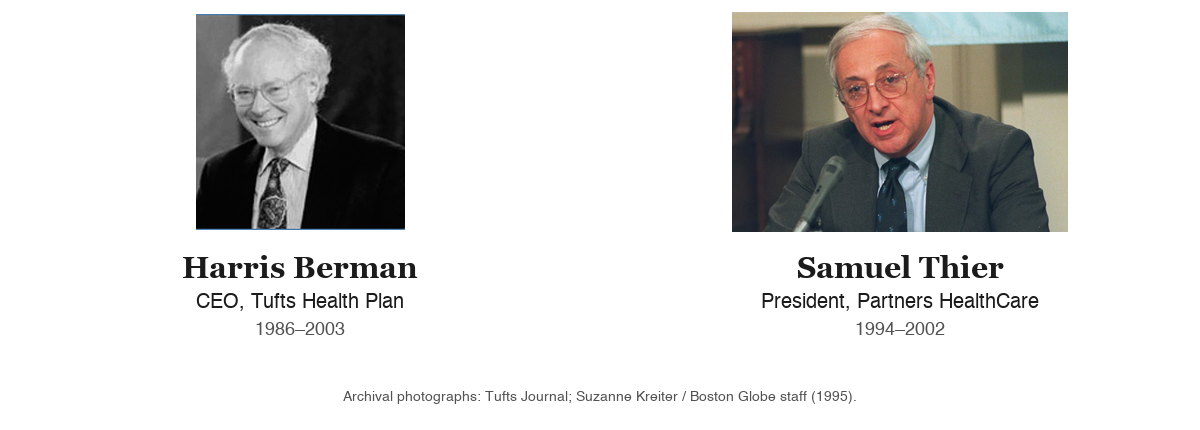
On October 23, 2000, Harris Berman, the CEO of Tufts Health Plan, arrived at Partners HealthCare’s headquarters in Boston’s Prudential Tower, expecting another round of contract negotiations. I like to imagine he strolled through the Pru’s shopping mall, rode the elevator to the 11th floor to corporate office (affectionately nicknamed “Carpet World”)1 and was looking for a handshake agreement. What Berman didn’t realize is that he was heading into a meeting he would later describe as an “ambush”.
Berman had built Tufts Health Plan by growing its membership fifteenfold, from 60,000 to 900,000, making it the third-largest insurer in the state. A physician who had co-founded one of New England’s early prepaid medical groups, he was known for developing alliances and bringing people along. Being liked in healthcare politics isn’t easy, but he had confidence he could reach an agreement with Partners.
Partners’ CEO, Samuel Thier, had a different idea of how the negotiations would unfold. A kidney specialist, he had led Yale’s medical department, the Institute of Medicine, Brandeis, and MGH. Now he ran Partners, the parent company of Massachusetts General Hospital and Brigham and Women’s Hospital, and believed insurers had held hospital prices down for far too long. The teaching hospitals trained Harvard medical students, conducted Nobel Prize-level research, bought cutting-edge medical technology, and took the most difficult cases in the world - all of which need massive money. Thier thought of Partners as something closer to a university, with research responsibilities to match. With Medicare cutting payments, he wanted a “reset” with the commercial plans. Berman was trying to keep insurance affordable; Thier wanted insurers to pay for the institution he was running.
Partners claimed the Tufts contract had lost $42 million over two years, after half a decade without a rate increase. It wanted Tufts to cover more costs of the teaching hospitals’ work.
Tufts disputed that rate history and put Partners’ demand at 27% more over the next two years. It was supposed to keep health costs down for its customers, but paying Partners that much more would mean charging employers higher premiums. Tufts had posted its own loss in 1999, and it had watched Harvard Pilgrim, the state’s largest HMO, enter state receivership in January 2000. Tufts had to decide how much it could afford to pay Partners and how much its customers would accept in their next insurance bill.
Berman had come to the Pru expecting to work through those numbers. Instead, Thier told him Partners would leave the Tufts network. Partners had already prepared a public campaign to take the dispute to its patients, Berman later testified, while Tufts still thought the private negotiation was alive.
The public campaign began almost immediately, ahead of November’s open enrollment. Banners suddenly appeared in Partners’ hospital cafeterias warning patients of the Tufts exit. Posters quickly went up in admissions areas and doctors’ waiting rooms for prospective patients. Partners sent letters to physicians and patients, recorded telephone messages, opened a hotline, and built a 90s-era website. Nervous patients heard rumors that their doctors might stop accepting Tufts insurance. The backlash against Tufts was in full-effect.
Cable TV sees the same situation play out with their subscribers. ESPN disappeared from Dish Network just as fans settled in for a Saturday of college football, and furious subscribers threatened to cancel - imagine planning for college gameday, then being offered the Hallmark Channel as consolation. A fan who switched services took the whole subscription payment along, which made one missing channel a problem for the entire business. Partners was counting on patients feeling the same way about their hospitals.
Seventy-five other hospitals
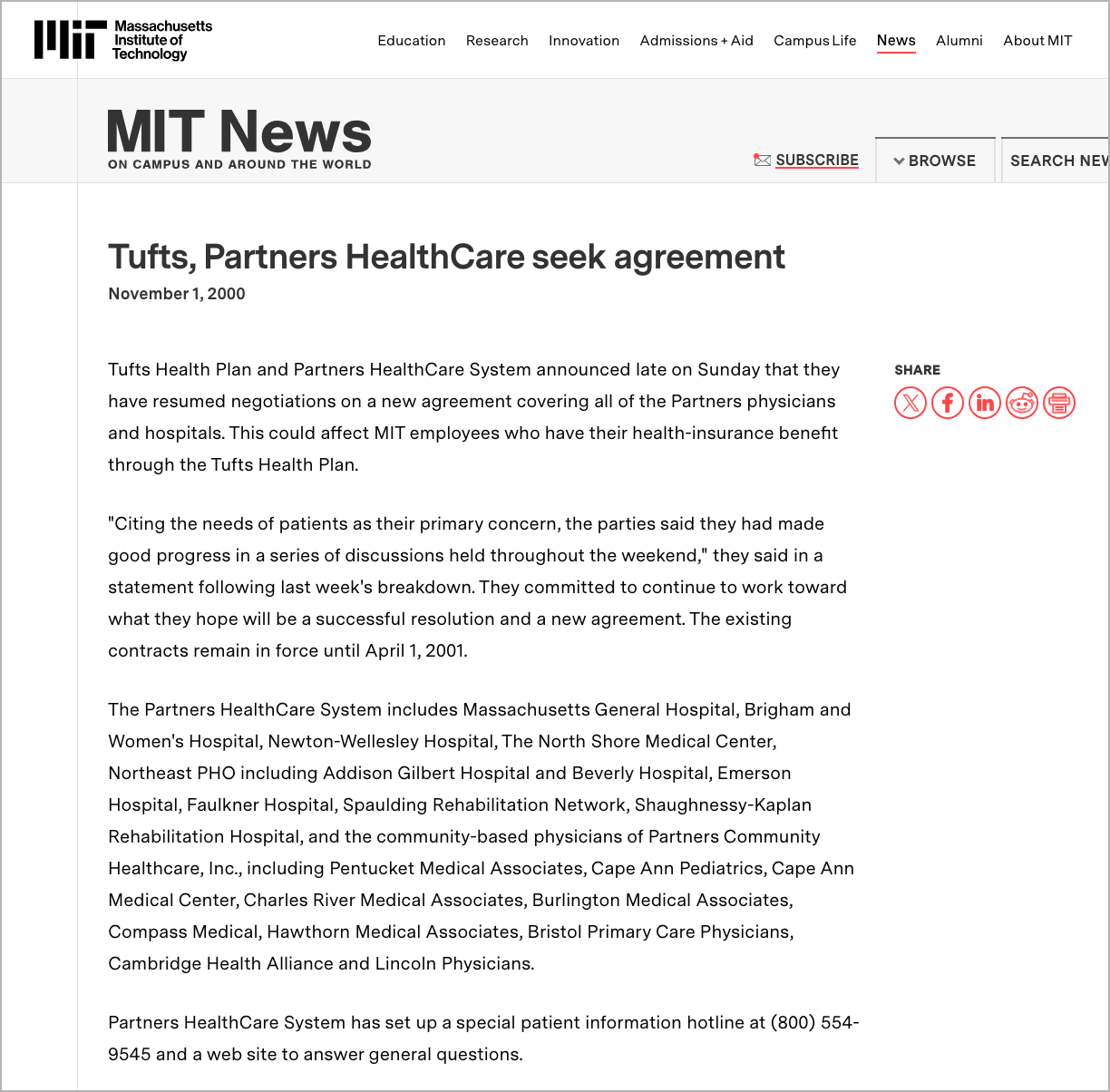
The threat reached employees just as they were preparing to choose next year’s insurance. MIT had a bit over 10,000 employees in 1999. For employees who chose Tufts coverage, its benefits office laid out the problem in a November 1 notice: the Partners contract would last until April 1, 2001, but employees would choose their coverage during a ten-day window that November, for benefits beginning January 1. If the dispute continued, they would have to choose a plan before knowing whether it would still cover their doctor in April. The dates were confusing enough on paper - now imagine making the choice with a physican you hoped to keep.
Imagine a janitor at MIT seeing a Partners psychiatrist. He could stay with Tufts Health Plan and find a new therapist, switch to Network Blue and keep the doctor, or join an MIT plan with referral-limited access to MGH and the Brigham. He could talk to his HR department, looking through directories, phone numbers, and an e-mail address for help sorting through the choices - a tremendous amount of effort for one person trying to keep one doctor.
Even though Tufts could offer 75 other hospitals, the bundle didn’t matter to members who wanted the top hospitals. And if Tufts members wanted MGH and BWH, they also had to take in the bundle of nine hospitals under the Partners umbrella - including community hospitals north and west of Boston, along with rehabilitation facilities, specialty practices, and thousands of physicians. Only about 20% of Tufts members used a Partners doctor, but apparently Mass General and the Brigham had reputational value even to the members that did not use them.
Members called their employers. Employers that had spent years telling Tufts to hold premiums down changed their instructions. Bargain hard, save us money, but please don’t change anything our employees care about. Berman said major accounts told him that a Tufts plan without Partners could not be offered to their workers. In the middle of a sleepless night, Berman recalled, he reached the conclusion that Tufts’s own survival would be at risk if it lost those accounts.
Tufts felt it had no choice but to return to the table. On November 1, before MIT’s enrollment window opened, the parties announced an agreement. Tufts had agreed to pay more to keep Partners. Members kept their doctors and hospitals, and the system kept on moving. The rates stayed private.
Almost out of the business
More than two years later, on February 28, 2003, Berman explained the retreat at an FTC/DOJ hearing on hospital competition.2 At sixty-four, he was preparing to retire after thirty-two years in managed care.
An earlier speaker had remarked on the kinder, gentler, more cheerful managed-care executive. Berman offered an explanation for his own smile: he was leaving for academia. Age had helped with the mellowing. Retirement would help with the rest, though first he had another negotiation with Partners in a few months. He told the hearing that even discussing the system made him uncomfortable. The audience had come to examine what happened last time; Berman still had to think about what would happen next.
Tufts had survived the confrontation and kept its customers. Now it would have to bargain again for the same hospitals those customers had insisted on keeping. To explain why walking away had been so difficult, Berman described a phone call from a member.
She had been happy with Tufts for years, had never needed Massachusetts General Hospital, and hoped she never would. Still, if Tufts lost Partners, she planned to find another insurer - because if she became seriously ill, she wanted MGH within reach.
She was choosing insurance for an illness she hoped never to have, buying access to specialists she hoped never to meet, at a hospital she hoped never to enter. Mass General and the Brigham had spent years acquiring that expertise, training doctors and developing treatments. She could value all of it before she ever made an appointment.
If MGH was built for the worst day of your life, how did that give Partners leverage over all the ordinary care around it?
Tufts had no choice but to buy access to MGH through a contract with Partners - and the whole bundle of other hospitals and physicians, too. That anonymous member’s wish to keep one hospital within reach helped Partners bargain for the whole network. Multiply that preference across an employer’s workforce, give those workers another insurer to choose, and Berman’s problem comes into focus. Mass General could keep its place in their lives while Tufts lost its place on their insurance cards.
Partners had another partner
On December 28, 2008, the Boston Globe’s Spotlight team published its reconstruction of the fight. It sent the story back to May 2000, five months before Berman’s ambush at the Pru.
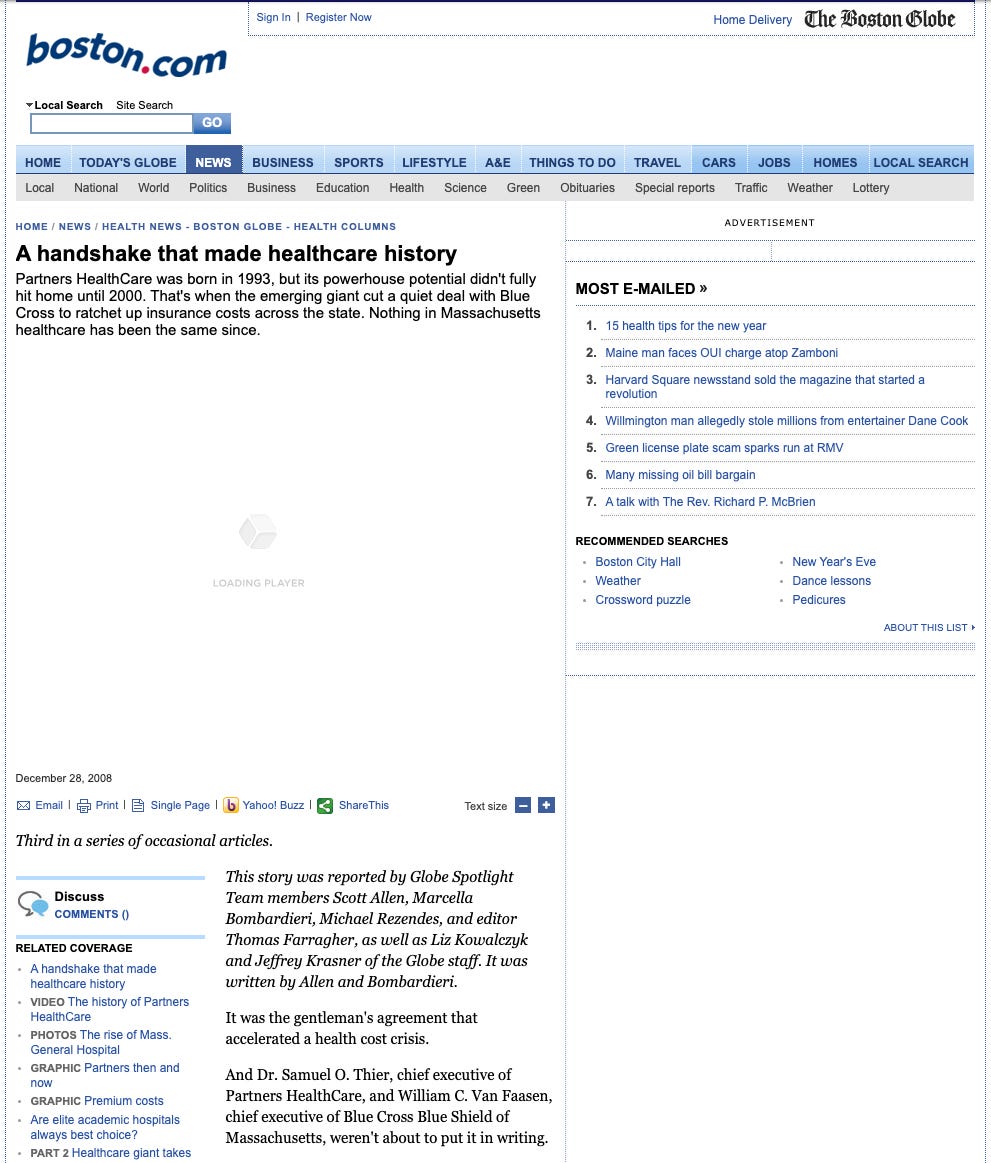
Partners had already reached a private agreement with Blue Cross Blue Shield of Massachusetts - now memorialized in what the Spotlight team called “the handshake that made healthcare history”. The Globe reported that Blue Cross agreed to pay more on the understanding that Partners would seek comparable increases from its competitors. An internal Partners memo reviewed by the newspaper put Tufts’s offer $81 million below what would match Blue Cross.
Blue Cross Blue Shield of Massachusetts was the state’s largest insurer - the top dog in the market by more than double the next highest. It wanted to level the playing field and had Partners press competing insurers for comparable increases. For Blue Cross, paying more would be less of a disadvantage if its competitors had to pay more, too. The handshake had already changed what Tufts was being asked to pay, without Berman in the room.
And there was Blue Cross again, on MIT’s enrollment form, ready to take the business if Tufts refused. An employee could leave Tufts, keep the doctor, and send the next premium to the insurer whose agreement had helped put Tufts in this position. Blue Cross could be part of the problem for Berman and the solution for his customers. Convenient, if you were Blue Cross.
Members wanted Mass General available. Their employers therefore needed an insurer that could offer it. Blue Cross already could; Tufts could do so only by paying Partners. By the time Berman sat across from Thier, those choices had reached the bargaining table. Members chose an insurer to keep the hospital; Tufts had to keep the hospital to keep the members.
Six dollars, give or take
Tufts had paid more to keep the hospitals in its network. Paying for them would take longer. During the October negotiations, it agreed to higher costs after already setting the premiums it would collect in 2001. Tufts spread the added contract costs over three years and said higher premiums would follow in 2002 and 2003. Employers first asked Tufts to hold the price down, then told Tufts to make the deal with Partners. And at next year’s renewal, employers would pay the higher premiums.
Employees would encounter the bargain in their benefits, too. Tufts’s 2002 tiered plan offered premiums about 5% lower. Members kept access to both kinds of hospital. The plan changed what they paid when they used one.
If a member chose:
A community hospital: the member has a $350 copay
A teaching hospital (such as MGH or the Brigham): the member gets a $600 copay
The lower premium kept both choices open, but using a teaching hospital cost $250 more. And almost no one took the deal: six months after the plan was introduced, fewer than 1% of Tufts’s roughly 900,000 members had enrolled in the cheaper option. The market speaks for itself.
Tufts eventually made the business work. Its Associated HMO reported a roughly $43 million underwriting gain in 2005, after medical and administrative expenses. Premium income had caught up with costs and left money over. Employers and workers still had to find room for the insurance bill. An insurer’s recovery offered them little comfort if the coverage itself kept getting more expensive.
Over a period of years, Tufts could recover by bringing premiums back above costs. They simply weathered the storm. Employers and workers had no similar escape hatch - their insurance bill simply kept climbing.
Across Massachusetts, the bill was getting larger. In the state’s fully insured HMO study, medical costs rose from $154 per member per month in 2002 to $239 in 2006, an increase of 55% over four years.
That increase did not come mainly from people using more inpatient care. Admissions were essentially flat, population risk was stable, and membership fell. The cost of each hospital stay rose by more than 10% a year.
Against that much larger bill, how much extra might it have taken to keep Partners?
The settlement stayed private, so take $27 million a year as an illustration - the midpoint between a low estimate of $21 million and a high estimate of $33 million.3
Spread $27 million across the HMO’s 392,893 members and it comes to $5.73 a month, or about $69 a year, per member. Against $1.813 billion in annual premiums, the same $27 million is about 1.5 cents of each premium dollar.
After the banners, the hotline, the sleepless night, and eventually a federal hearing, the modeled cost came to about six dollars a month. Not nothing - but less a financial calamity than a very Boston subscription fee, paid to keep Mass General and the Brigham within reach. At that price, keeping MGH and the Brigham available looks like a compelling bargain. You can understand why someone would choose it, and choose it again the following year. The hospitals had spent generations becoming places people wanted to reach when something went badly wrong. Bostonians had good reason to want them close. You do not have to live in Boston to understand the appeal.
The hospitals Tufts had to keep
Berman’s caller wanted MGH available if she became seriously ill. Enough members wanted the same thing that employers needed it in their benefits, and Tufts needed it to keep those employers. Securing that access meant reaching an agreement for the larger Partners network. Each member was trying to keep a hospital available; together, they were setting a condition under which Tufts could stay in business.
Members were choosing where they could receive care. Their insistence on keeping MGH and the Brigham also helped Partners bargain for hospitals and physicians those members might never use. Partners negotiated for those providers together; demand for the flagships helped keep the rest of the network in the contract.
Years later, Tufts was still paying MGH and the Brigham about 30% more than its average hospital. It could bargain over the price of keeping them. Going without them remained the harder proposition.
Tufts did eventually negotiate substantial concessions. It also joined another major insurer (aforementioned Harvard Pilgrim - the no. 2 under state receivership) and formed Point32Health, promising that a larger company could make coverage more affordable. The insurer across the table had grown, but it still needed the same hospitals.
The 2000 fight is just an example of all the disputes that follow the same playbook. But it’s clear that these disputes give a reason for insurance companies to consolidate too. An insurer could win concessions, change its offer, even join another insurer, and still have to bargain with the hospitals its customers wanted. Insurance acale was answering hospital scale. The settlement had ended the confrontation; Tufts would keep returning to hospitals it could scarcely afford to lose.
Berman’s caller had been happy with Tufts, had never needed MGH, and hoped she never would. She was prepared to leave her insurer to keep the hospital within reach. Tufts made the deal, Mass General stayed, and the door remained open - for a woman who hoped never to walk through it.
There was a gem of a quote from Catherine Robbins who described the Partners’ corporate offices as “Carpet World” above a shopping mall from John Kastor’s Mergers of Teaching Hospitals in Boston, New York, and Northern California
The basis for most of this series is based on a frank FTC and DOJ hearing transcript about hospital consolidation (why is the FTC looking at this?). No one was on trial, but it was just a hearing titled, “A Tale of Two Cities” to look at two different healthcare markets in Boston and Little Rock, Arkansas. Coincidentally, a winter storm iced in the Little Rock participants, leaving Boston alone on the morning’s agenda. So we end up with this great scene where only Boston’s panel of healthcare execs are entering the public testimony, and it gives this great inside view into their decisions.
Methodology: the low estimate is half of Partners’ $42 million loss over two years = $21 million. The high estimate is one-third of the roughly $100 million three-year negotiating gap later reported by the Boston Globe = $33 million. Midpoint is $27 million, and divided by the per-member calculation from a 2005 filing. The later-year base gives a sense of scale; $5.73 is an estimated charge.
Great article.
A long, long time ago I was in a meeting where it was pointed out that, while you couldn't get a kidney transplant at Quincy City Hospital, that didn't explain why having your gallbladder out at MGH cost 3X what it cost in Quincy (8 miles apart).
Well, Quincy City Hospital is long gone, a ruin, and MGH is going strong.
But healthcare economists still can't solve the question of that very expensive gallbladder operation at MGH.