


Healthcare only industry in the room for your first breath - and it bills you for it.
The only industry in the room for your last one - and its claim outlives you.
The only industry that hires more humans every year to take care of everybody else.
The only industry whose best work is the sickness you never knew was coming.
The only industry that’s left holding the smoker’s lungs, the drinker’s liver, and the soda kid’s blood sugar - long after everyone else has cashed out.
The only industry that still needs a person at the bedside when the machines do the rest.
The only industry that has nearly a fifth of everything we make, and is still growing.
Healthcare should keep growing. It is the only industry whose whole product is human capacity—more years, and more ability to use them. It is the only industry that takes in the damage every other industry leaves behind. I don’t care how big tech, retail, autos or manufacturing get. Past a point we stop wanting more of what they sell, and none of them gets handed the bill for anyone else’s harm. As their machines take over more of the work, healthcare is where our money, our people, and our ambition should go. It will grow into whatever we pay it to do.
We usually treat that growth as evidence of failure when it’s not. I read enough healthcare articles to recite the evidence with my eyes closed: $5.3 Trillion, 18% of GDP, more than $15,000 per person, roughly 24 million jobs in healthcare and social assistance. And yes, the bill is too high, and we’ll get to that later.1 But plenty is still missing, like cures for diseases we can’t yet treat, appointments people can’t get, and enough nurses for the patients already in the beds. Every one of those would make the industry bigger, and every one of them is worth buying. And who cares if more of our money is going to health - what if the point of getting richer is to buy more life?
That sounds backwards mostly because of one word. Calling healthcare an industry makes people uneasy for good reason. A doctor becomes a provider, a patient becomes a consumer, and someone having a heart attack becomes a market opportunity. But cars take us places, phones let us talk to people, and films give us something to argue about afterward. Healthcare gives us more time and more ability to do any of it. The trouble is deciding how much of its growth buys more life, and how much buys more business.
Five Trillion is Chump Change
Healthcare is oft-cited as a $5.3 Trillion industry - as if that meant anything at all. It might as well be the size of Jupiter; the scale doesn’t even register. So I don’t flinch at 18% either. Healthcare is 18% of the economy. 18% of GDP. 18%, and climbing. Everyone who mentions 18% says it like a diagnosis, and say 18% enough times and it stops meaning anything. I think 18% is too little. What healthcare makes is more years and more ability to use them, and that’s the one thing people keep wanting more of as they get richer.
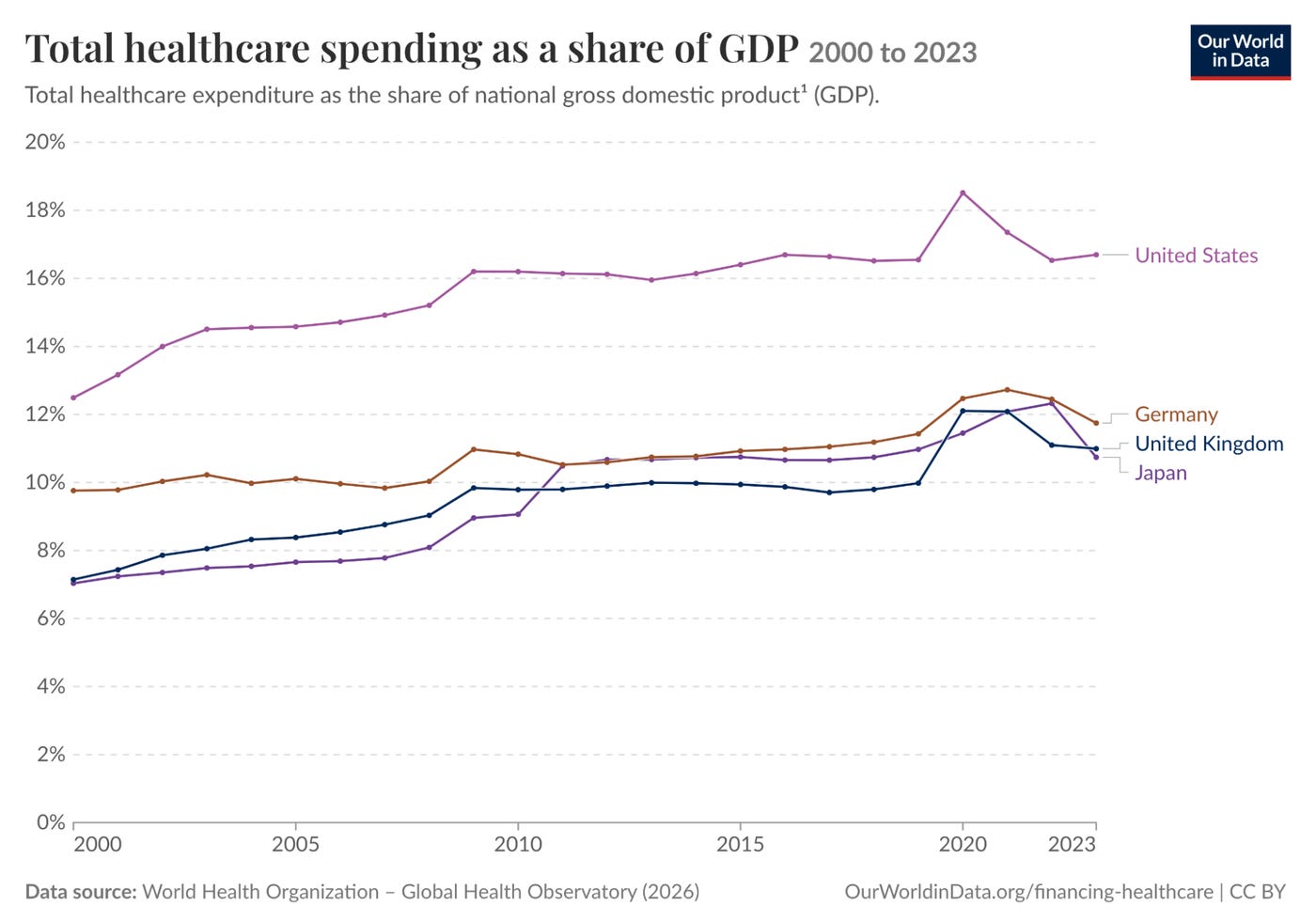
Getting richer makes people want more healthcare, everywhere. Nobel winner Robert Fogel measured that for every 10 percent richer we get, we spend about 16 percent more on health. So health takes a bigger share of every raise. You can see it across the big economies. The U.S. went from about 5% of GDP in 1960 to 18% in 2024, and the United Kingdom, Germany and Japan climbed too. The UK runs a national health service, Germany uses nonprofit sickness funds, and Japan has thousands of insurers, yet the line goes up anyway. The climb tracks getting richer more than how any one country pays for care.
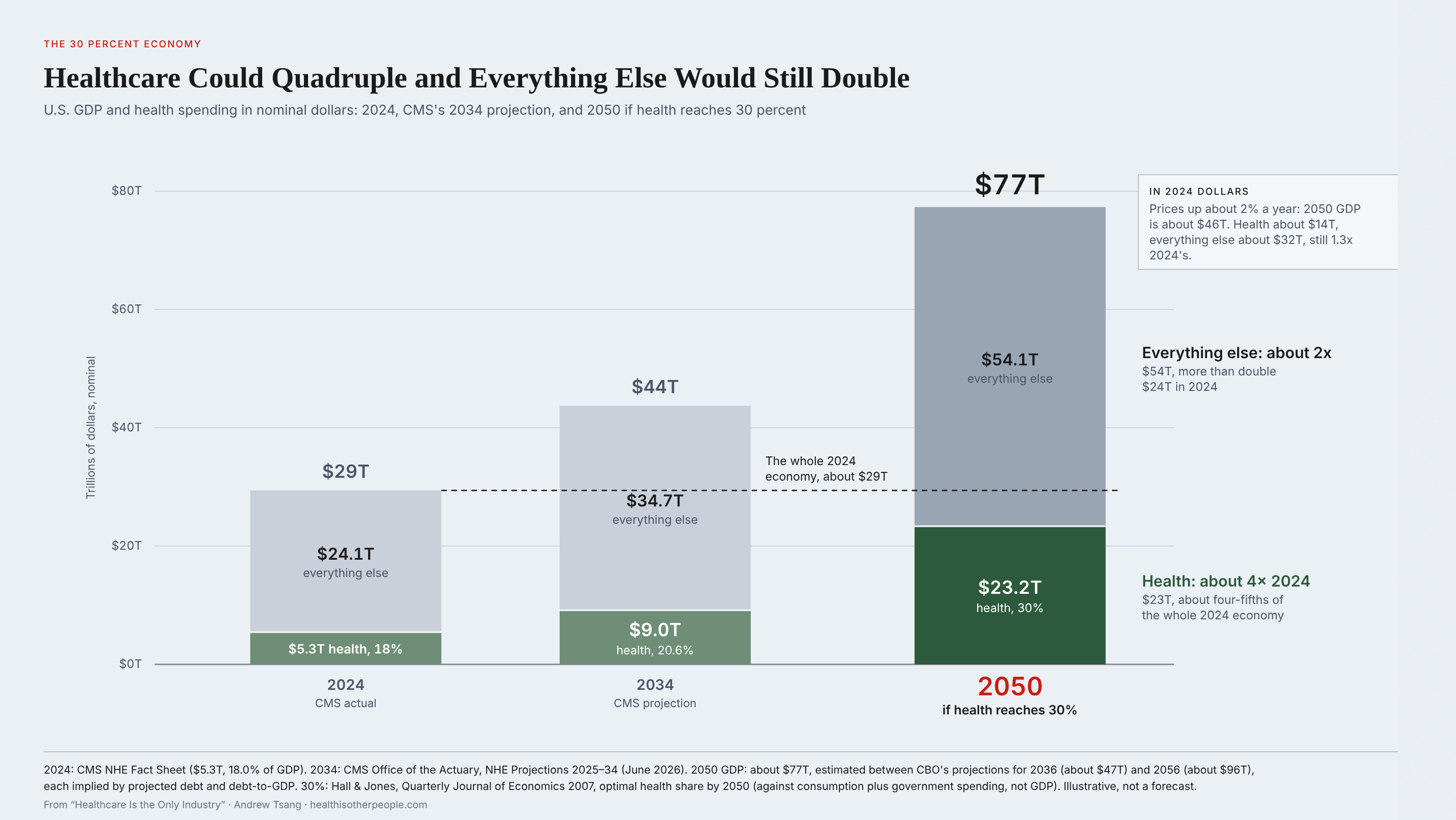
America has found its own way to make care expensive - but it’s not alone in its demand for healthcare. There’s a wild paper by Stanford economists Hall and Jones explaining why the demand grows. Each extra thing we buy adds a little less, while each extra year of life gives us more time to enjoy everything we already own (by that logic, Amazon should keep us alive to buy more stuff). In their model, the best share for health keeps rising with income and passes 30% by 2050. Even at 30%, healthcare would be nearly the size of today’s whole economy, and everything else would still be twice as big as it is now.2 The question is whether we’d gladly spend a third of our economy on more healthy years.
I can run out of things I want to buy long before I run out of things I want to do. Another healthy year gives me time with my kids, time to write, time to use what I already own - and if I’m greedy, buy more stuff. But as we get richer, a third TV adds almost nothing - yet another healthy year adds almost everything. We stop wanting more for our time and start wanting more time for what we have. That is what economic growth is supposed to buy. I care about the work people can do when they’re healthy, and I also care about the days they can spend doing absolutely nothing useful to an employer. The point of another healthy year is that you get to have it.
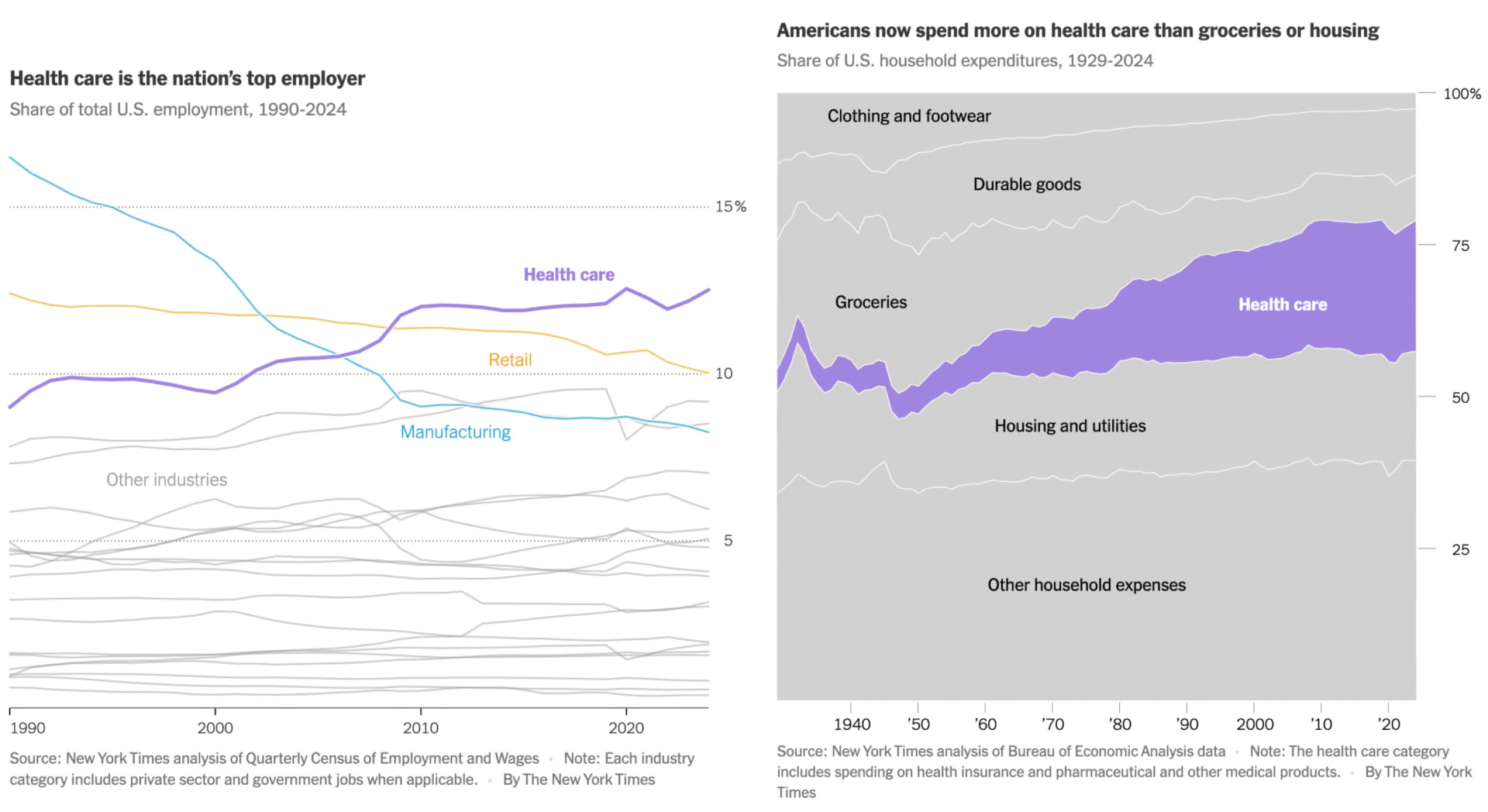
The money is only half of it. Healthcare is now the country’s biggest employer, ahead of retail, with about one in eight American workers. An economy that needs fewer people making refrigerators can afford more people helping someone get out of bed.
Incredibly Large and Very Short
The obvious objection is that America already spends too much and gets too little for it - which is a fair argument against healthcare growth. We have managed to make a very large industry feel like a shortage. America spends more on healthcare than any country on earth, almost twice as much per person as comparable wealthy countries, while getting about half as many in-person doctor visits. Try finding a primary care doctor taking new patients, or a therapist, or a nurse with time to sit down. No other industry can be the biggest thing in the economy and still leave people waiting in line. But the line isn’t there because we want too much care.
Part of the wait comes from work only a person can do, and a person can’t be sped up or split between two beds. This effect is best demonstrated in the classic (and classical) example of a string quartet: It needs the same four players and the same time to play Mozart’s No. 19 in C as it did 250 years ago, yet it costs far more, because the musicians’ pay has to compete with the modern labor market. A hospital still needs someone to help a patient eat, wash and recover, and that person’s pay has to keep up with the factory down the road, where the same work takes fewer hands every year. This economic effect is widely known as Baumol’s cost disease. In typical healthcare discourse, it usually gets cited as a death sentence—proof that care costs will climb until they eat the whole economy. William Baumol himself wrote a whole book saying that people get it backwards, with a chapter titled “Yes, We Can Afford It” (we should just end the essay here). Care only looks pricier because everything else keeps getting cheaper. A nurse’s hour costs more each year because every other hour got more productive, and that same productivity is what makes us rich enough to pay her.
Now I won’t defend the efficiency of US healthcare spending, because too much of the money never reaches the care. I’ve written plenty about healthcare waste, market power, and the elaborate business of getting someone else to pay. We can cut the work of disputing a bill without cutting the time a nurse spends with a patient. Paying more people to care for us, and paying more to get past the billing department, both show up as healthcare spending. A $5+ Trillion total is impressively large, yet remarkably ambiguous about telling us which kind of healthcare system we bought.
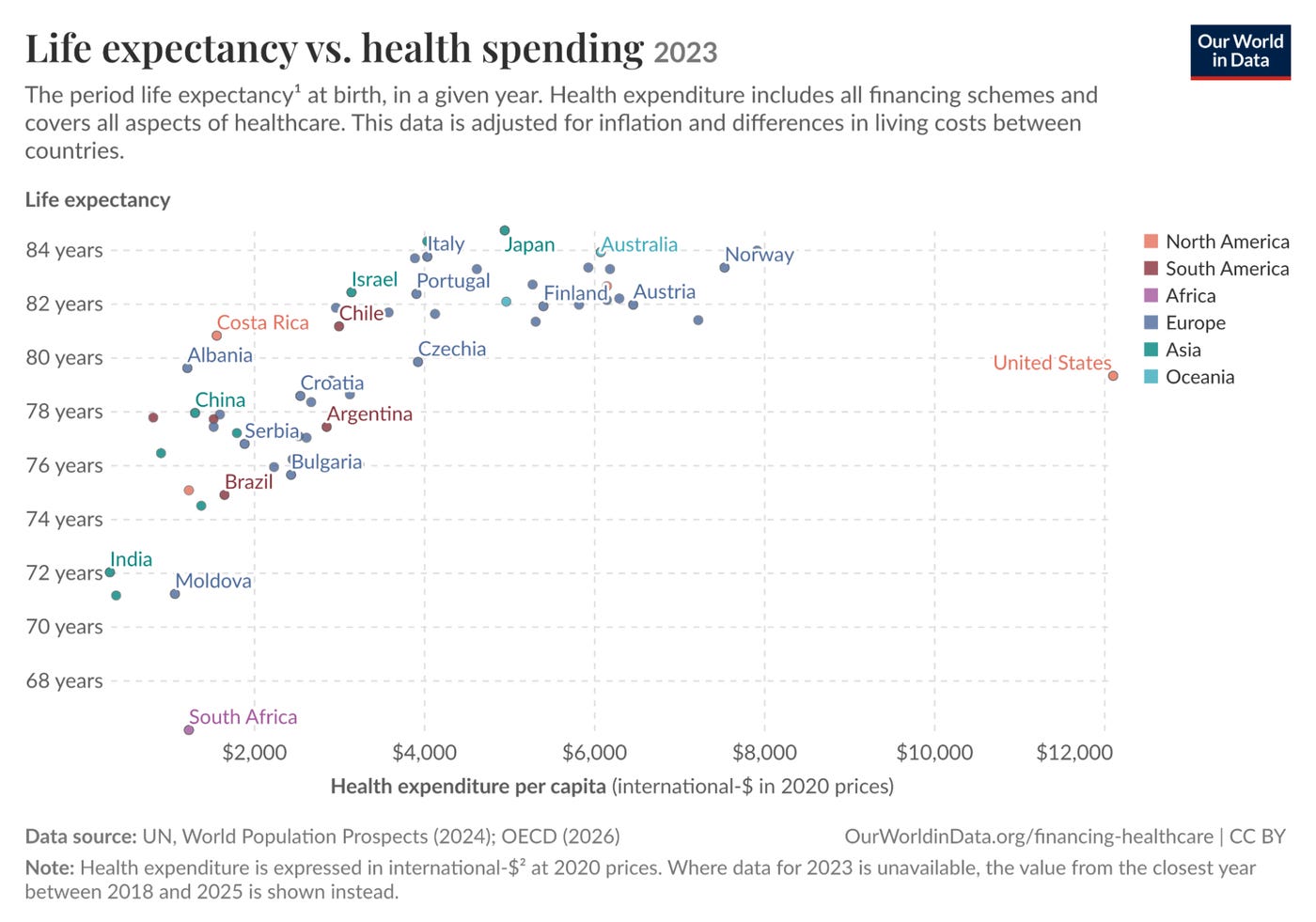
So cut the waste, and spend every dollar it frees up on care. Even at $5+ trillion, healthcare is chump change next to the years it buys when it works, and the people it keeps well enough to use them.
Everything Drops Into Healthcare
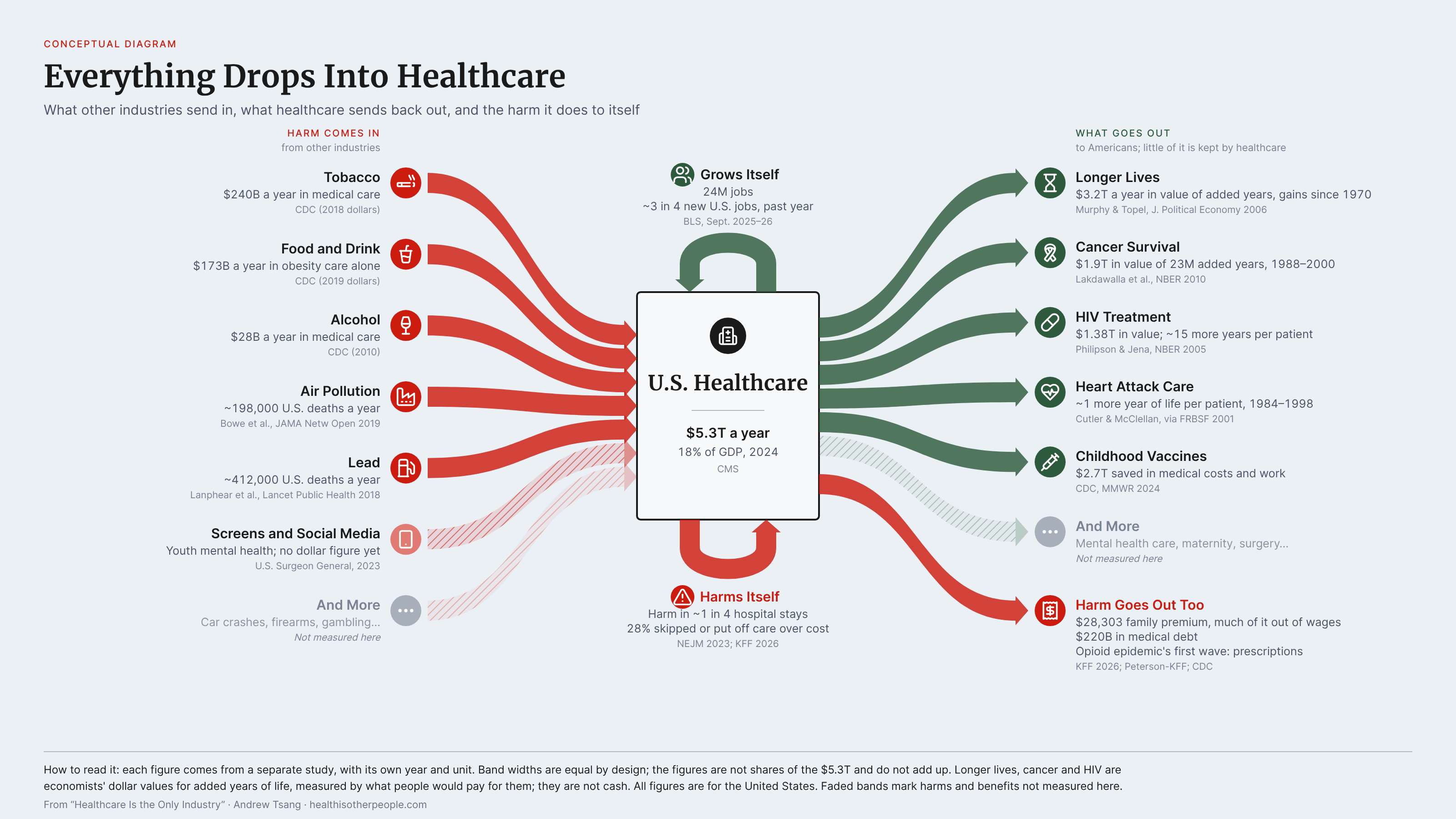
Healthcare is also the only industry that takes everyone else’s shit. Every other industry gets to sell its product and walk away. Whatever that product does to the people who bought it—the smoke, the sugar, the pollution, the job that wore out a back—ends up in a clinic or a hospital bed. And whatever healthcare returns—the kid who makes it to school, the parent who makes it to work—gets booked to somebody else. Healthcare carries the expense coming and going. No other industry sits at the bottom of the economy like that, catching what falls and sending people back up.
The Economic Return
Let’s start with what flows out of the system. When my kid is too sick for school, my workday changes too. My insurer can count what it paid for the visit, yet my clients and the school don’t send it a check for the trouble they were spared. Economic studies on vaccination (plz don’t @ me) let us measure the impact. For American kids born from 1994 through 2023, the CDC figures vaccines cost us $268 billion and saved $2.9 trillion. That’s $2.7 Trillion we got to keep, and most of it never touches a medical bill. We pay for the shot and the work of getting it into an arm. The return includes children who never get sick, parents who don’t have to miss work, and lives that aren’t cut short. A healthcare budget pays for benefits that other people’s budgets get to keep.
The Healthcare Economy’s Smoking Gun
That is the generous side of the accounting, where healthcare produces benefits other industries get to keep. The other side coming in shows that healthcare treats damage other industries get paid to cause. Due to size alone, tobacco use is the best example. A cigarette company books a sale and keeps the profit. The lung disease shows up years later, in a clinic, on an insurer’s claim, in a hospital bed, and the company never sees that bill. Cigarettes are a textbook example of a negative externality, a product whose harm lands on people who were never part of the sale. Smoking generated more than $240 billion in healthcare spending. The bill got big enough that states sued the tobacco companies to claw back the public money spent treating smokers, and a 1998 settlement with forty-six states still has them paying. It took a nationwide legal fight to send even part of smoking’s bill back out of healthcare.
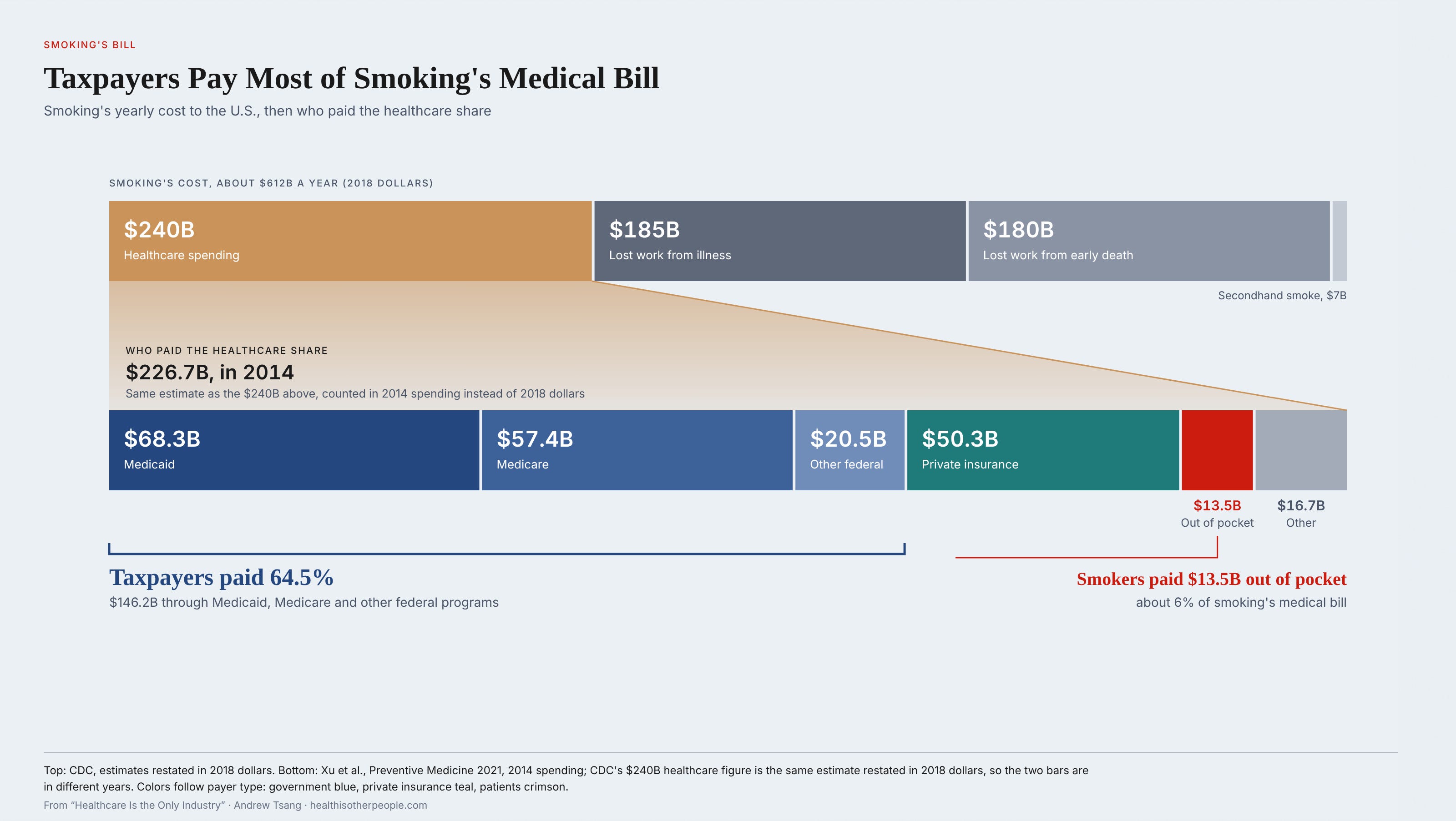
Part of what we call healthcare’s cost problem is really the cost of everybody else’s products. The smoker’s cancer treatment still enters the accounts as healthcare spending, where it joins the evidence that healthcare costs too much. Yes - hospitals can overcharge, insurers can overburden, and drugs can be overprescribed. But this patient arrived with a disease a cigarette company was paid to cause! Fixing the billing department won’t undo what put them in the bed.
Tobacco just happens to be the one we sued to recoup healthcare costs. Nearly everything this economy sells comes with a side effect, and every side effect clogs up a waiting room. We eat food that is manufactured to be addictive - and obesity alone is tied to $173 billion in annual medical costs. We breathe whatever the plant upwind is burning. We drink water where forever chemicals show up in nearly half the taps in the country. We hand our kids phones full of feeds and ads built to keep them scrolling. Each of these industries sold something people wanted, and healthcare got the patients. There’s no master budget to deal with the harm of the drive-thru, the smokestack, the water main or the feed (both livestock and algorithm). Researchers can only measure some of these harms, and the measurable ones alone trace to about a quarter of everything America spends on healthcare. Healthcare is the only industry that has to absorb all of it, and every dollar gets counted as healthcare’s cost.
The Home for Healthcare
The way these negative externalities are usually addressed is through public health. Clean the water, tax the cigarettes, put guardrails on the highway, and fewer people end up in the hospital. Ergo, that spending is healthcare spending too. Every dollar spent preventing the damage is still a dollar spent on health, so even the fix makes healthcare bigger. It just buys the years upstream, before anyone needs a bed.
If healthcare receives the damage, the next question is whether it should pay to prevent some of it - medicalization is really a philosophical question rather than a pragmatic one. Housing is where that question has the best evidence. In Denver, a program offered people experiencing chronic homelessness and frequent arrests a permanent place to live, rental assistance, and support to help them stay housed. Places were offered at random, so researchers could compare the two groups. Among those whose care could be tracked through Medicaid, the housing group had fewer emergency-department visits and more office-based psychiatric care over two years. Giving people a home changed the care they needed. I don’t know that every housing program saves medical dollars. But once housing changes the need for hospital care, the line between a housing budget and a healthcare budget gets blurry.
So medicalize it. If the growth in healthcare spending bothers you, the fix is more of it, aimed upstream at the social determinants of health—the housing, food, income and safety that shape our health long before we ever see a doctor. Working with healthcare organizations to build programs around them was one of my best experiences. It adds responsibilities to a system already struggling with the ones it has, and I still think it should lean all the way in. We can exclude housing, food, and income from healthcare’s definition. We cannot exclude their consequences from the hospital, so we might as well pay for them before they get there.
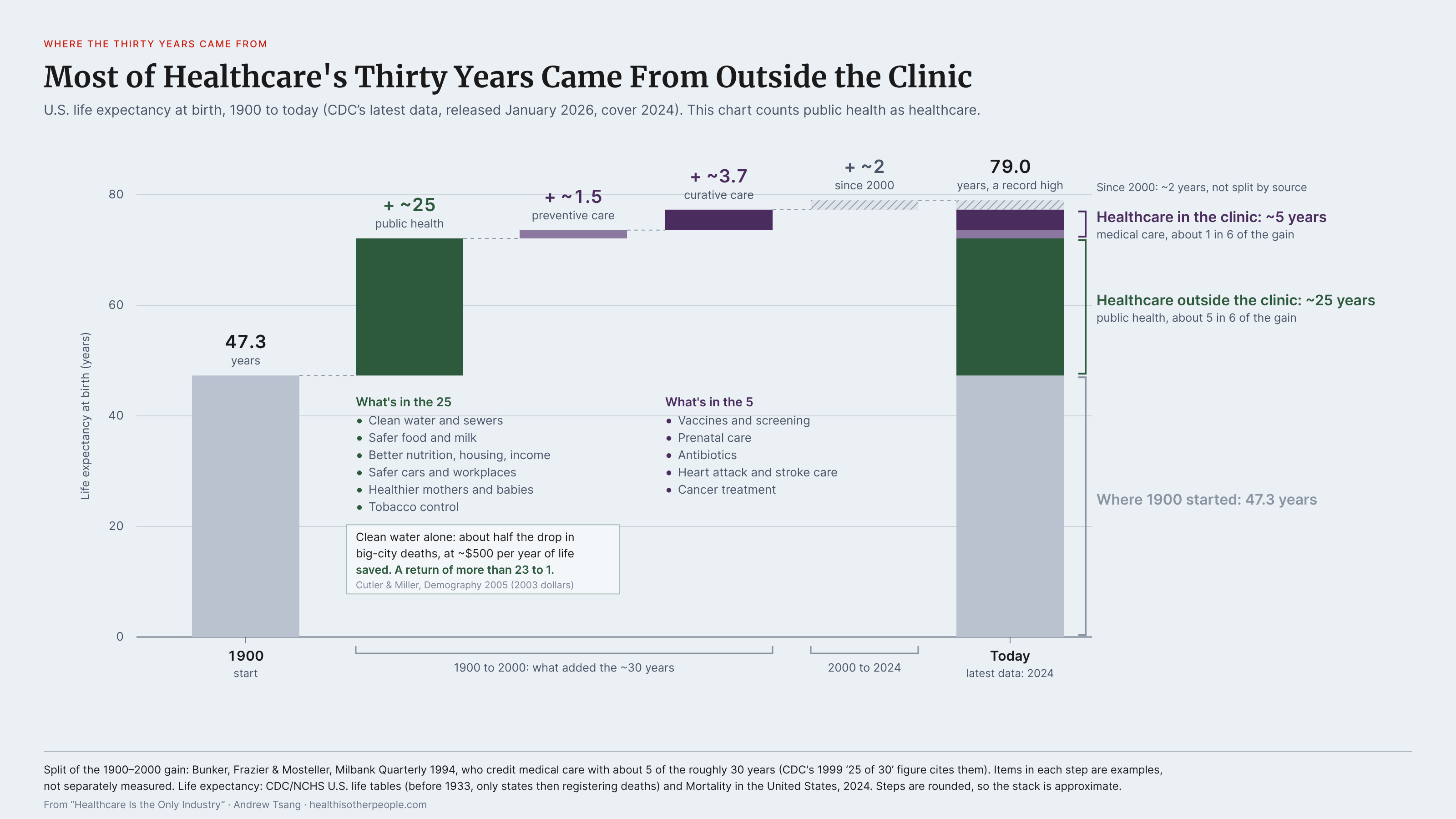
So where does healthcare stop? I would argue that it doesn’t. People keep finding new ways to get hurt, and each one becomes something healthcare has to treat. That’s part of why the bill keeps rising, and it’s why the boundary keeps moving. Healthcare keeps becoming more of the economy because more of the economy turns out to be healthcare. So healthcare will keep growing into what we pay it to do.
Growing Up
While working on both sides of the healthcare payment process, I’ve learned to understand why a hospital bills for a check and an insurer checks the bill. Give each an AI system and the hospital can document more of the care it can bill for while the insurer scrutinizes more claims. Each organization can become more productive at making work for the other. A faster appeal meets a faster denial, and the only thing that grows is the paperwork.
Healthcare is headed from 18% toward 30% either way, so the question is what that growth buys. Today we mostly pay per visit, per test and per claim, and a practice paid per visit will spend whatever time AI saves on more visits. Paid that way, healthcare also grows its own harm, in medical debt, skipped care and infections picked up in the hospital. Pay the same practice to keep people well, and the time goes back to patients. Spent on years of life - that 30 percent would be the best investment the economy has ever made. Spent on claims and denials - it’s the crisis everyone keeps warning about. And if housing is healthcare and food is medicine, more of the economy is about to be paid per visit and per claim too. That’s the payment model to fix before AI speeds it up.
We seldom pay healthcare to add years of life, because whoever pays for the care is rarely the one who collects. A health plan pays for blood pressure pills today. By the time the pills pay off, the patient has switched plans, and the healthy years go to an employer and a family who never saw the bill. That’s the same misbooking that makes healthcare look like it’s failing. Prevention has it worst, because the harm it stops never shows up in anyone’s data. Chesterton’s rule is not to tear down a fence until you know why it was built, and prevention is the fence that looks pointless once the animals stop getting into the yard. A payment system that only pays for what it can count will keep buying claims. Pay for the years healthcare adds, and bill the industries that send the harm in.
Baumol isn’t the only economist healthcare gets wrong. In 1865, William Jevons noticed that as steam engines got better at using coal, Britain burned more of it. That usually gets cited as a warning that efficiency backfires - the same way Baumol gets cited as an example of healthcare inefficiency. The misreading is that whenever care gets cheaper - we just use more of it, and the bill goes up. But in healthcare, more use can be the point. AI is about to do that to everything it touches.
Honestly, productivity by itself is meaningless. An economy that doesn’t produce anything good for life doesn’t matter. Imagine AI writing a million ads, another AI deciding where to place them, a third generating the pages they appear on, and a fourth summarizing those pages so I don’t have to read them. More output, more invoices, more money for the owners, and somehow I still have to close a pop-up. Cheap ads get us more ads. In healthcare, the cheap unit will be whatever we pay for. If that’s care, Jevons is good news, because more health is arguably the whole point. If it’s claims, then we get more claims. Whatever we’re paying for when AI arrives is what it will multiply.
The Human Industry
Automation can do more for care than speed up the bill. AI will let most of the economy make more with fewer humans, the way the factory did, only faster. When it succeeds, we can afford to have more people doing work that still needs them, and healthcare is where the freed-up money and people should go, because its product is time with humans and more years to spend. Helping someone get out of bed is one use for that capacity. Giving a nurse enough time with the patient already in the bed is another. The Bureau of Labor Statistics projects that healthcare and social work will be about 37% of new American jobs from 2025 to 2035. Much of that demand comes from aging and chronic illness. I don’t celebrate people needing more care, but I do want an economy that can provide it. A treatment waiting to be invented and a treatment waiting for an available nurse represent different shortages. An economy that can afford the discovery ought to have an ambition for the nurse.
So here’s my answer to the question I started with: yes, the point of getting richer is to buy more life. Healthcare is the only industry whose product is more human life, the only one that takes in everyone else’s damage, and the place our money and people should go as machines take over the rest of the work. Thus we are left with an existential dilemma—making sure healthcare’s growth buys more life and less business. Healthcare is headed for a third of the economy whether we plan for it or not, and what we pay it for decides whether that third buys years of life or more paperwork. So cut the waste, pay for the years it adds, point the machines at the bedside, and stop apologizing for its size. Strip away everything else. What does that leave?
The only industry that takes the smoker after the cigarettes are sold - and tries to give him more time.
The only industry that sends people back to work, back to school, and back to their own lives - yet never sees the return.
The only industry that still needs a person at the bedside, and can finally afford one once the machines do the rest.
The only industry that pays people to look after other people - and has to keep choosing them over the bill.
The only industry that becomes whatever we pay it to be.
The only industry that is headed for a third of everything we make - and rightfully so.
The only industry that welcomes you into the world, spends everything in between trying to give you more - and tries to make leaving it less painful.
Healthcare is the only industry that matters.
With apologies to Don Berwick’s Triple Aim, cost is the number one problem in U.S. healthcare. Access and quality are problems too, but cost and affordability are at a boiling point. I’ve written extensively about it here, here and here - so if you’re thinking I’m advocating for more cost growth, consider this essay my devil’s advocate hot take.
Quick maths: CMS puts 2025 health spending at $5.7 trillion, 18.4% of GDP, so the economy is about $31 trillion (give or take). CBO’s long-term outlook implies an unfathomable $96 trillion of GDP in 2056, so 30% of that is about $29 trillion in healthcare spending. The other 70% is about $67 trillion, more than twice today’s whole economy. The tricky part is that these are nominal dollars, and Hall and Jones measure the health share against consumption plus government spending, a slightly different base from GDP.